
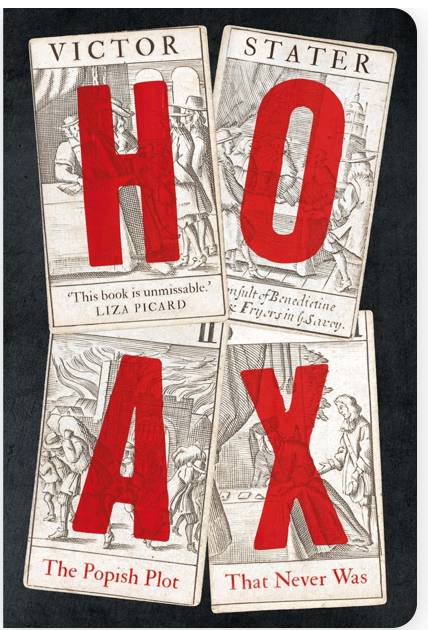
In 1678, a handful of perjurers claimed that the Catholics of England planned to assassinate the King Charles II. Men like the “ Reverend Doctor” Titus Oates and “Captain” William Bedloe parlayed their fantastical tales of Irish ruffians, medical poisoners, and silver bullets into public adulation and government pensions. Their political allies used the fabricated plot as a tool to undermine the ministry of Thomas Lord Danby and replace him themselves. The result was the trial and execution of over a dozen innocent Catholics and the imprisonment of many more, some of whom died in custody.
Victor Stater reveals the conspiracy theories which are a feature of our times as of centuries past.
The CIA was behind JFK’s assassination. The Bush administration had a hand in 9/11. The Covid Pandemic was masterminded by America’s “deep state”
Victor Stater’s Hoax: The Popish Plot That Never Was tells the story of what he calls “one of the most preposterous and consequential conspiracy theories of all time”. Between 1678 and 1681, England experienced an outbreak of mass hysteria with few parallels in the history. It rose from fear, whipped up by ambitious politicians, pamphleteer and peddlers of fantastical lies, that is vast, terrifying plot existed to kill King Charles II and return protestant England to Roman-Catholicism. There followed unfair trials and gruesome executions of several dozen innocent catholic layman and priests. Parliamentary opponents of Charles pressed for execution an attempt to ensure the monarchy remained protestant by barring James Duke of York, the King’s Catholic brother, from the succession. Exclusion failed and James became king in 1685 – only to be removed in the 1688-89 glorious Revolution, which put England on road of limited monarchy and parliamentary sovereignty that we know today.
Victor Stater thoroughly researched to recreate the feverish atmosphere of the times and wise in its assessment of the long term consequences for English politics.
Why did people believe in the plot? James, who stood to inherit the throne because the king had no legitimate children, was not only Catholic at court. Others included Catherine of Braganza, Charles’s queen and Thomas Clifford, a senior government minister. Charles himself was to embrace Catholicism on his deathbed. Suspicions grew in the 1670s that Charles planned to rule without parliament and with a standing army built up by the Earl of Danby, his chief minister. Critics viewed Charles’s foreign policy as too friendly to Louis XIV of France, Europe’s most powerful Catholic monarch. The government only lightly enforced laws on Catholicism in place since Elizabeth I’s reign.
Titus Oates, a fraudster and failed Anglican Vicar, gained access to the nation’s ruling circles and spun his yarn about a Catholic plot, Fake news. Charles, he alleged, was to be shot with silver bullet, or stabbed with specially made daggers or poisoned by Sir George Wakeman, the queen’s physician. Catholic uprising would follow in England, Scotland and Ireland.
The nonsense turned dangerous when Sir Edmund Berry Godfrey, a magistrate to whom Oates also told his tale, was found dead in a ditch at Primrose Hill outside London.
William Bedloe, a Bristol born counterfeiter, Swindler, petty thief and jailbird writes Stater.
Under England’s Treason Act of 1351, two witness were needed to convict a person in court for treason. Stater pins much blame for the hysteria on Anthony Ashley Cooper, earl of Shaftesbury, who may never have believed in the plot but who exploited it to advance his career and pursue Exclusion. But Charles II the Indolent King handled the crisis astutely. He offered concessions to his anti-Catholic opponents, but at crucial moments he prorogued or dissolved parliament, such that the head of steam behind Exclusion eventually fizzled out.
Charles II emerged from the crisis with credit, moderating the tempers of the time, and how, the catalyst for the later attempt to deny James II his throne through parliamentary action, it led to the birth of two-party politics in England.
The legacy remains with us even today.
Hoax: The Popish Plot That Never Was by Victor Stater, Yale University Press £20/$35, 356 pages
 The neptune Herald
Leave a comment