
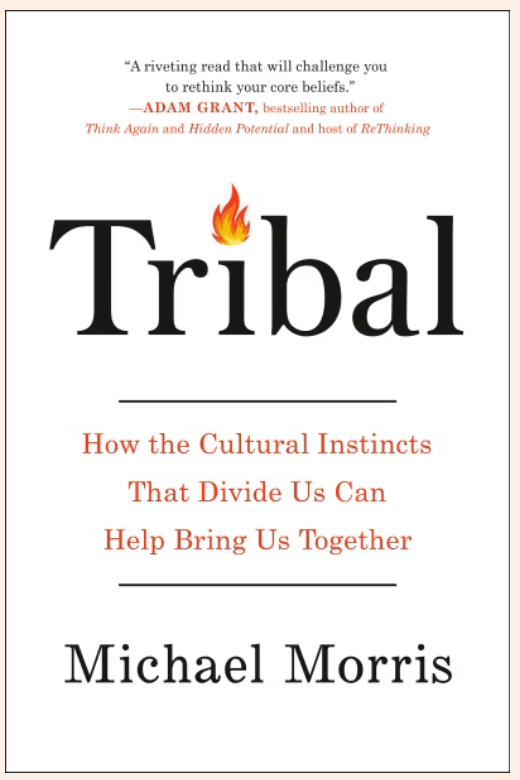
Tribal unlocks the deepest secrets of our psychology to give us the tools to manage our misunderstood superpower. Renowned Columbia professor and acclaimed cultural psychologist Michel Morris argues our tribal instincts are humanity’s secret weapon. Our is the only species that lives in tribes: groups glued together by their distinctive cultures that can grow to a scale far beyond clans and bands. According to Morris our psychology is wired by evolution in three distinctive ways. First, the peer instinct to confirm to what most people do, second, the hero instinct to give the group and emulate the most respected, and third, the ancestor instinct to follow the ways of prior generations. These tribal instincts enable us to share knowledge and goals and work as a team to transmit the accumulated pool of cultural knowledge onward to the next generation.
Countries, churches, political parties and companies are tribes, and tribal instincts explain our loyalties to them and the hidden ways that they affect our thoughts, actions, and identities. Rather than deriding tribal impulses for their irrationality, we can recognize them as powerful levers that elevate performance, heal rifts, and set off shockwaves of cultural change. Weaving together deep research, current and historical events, and stories from business and politics, Morris cuts across conventional wisdom to completely reframe how we think about out tribes.
Bracing and hopeful, Tribal unlocks the deepest secrets of our psychology and gives us the tools to manage our misunderstood superpower.
When it comes to how our minds work, people have a lot in common, but instead of bringing us together, our shared traits are doing a remarkably effective job of tearing us apart.
Morris emphasise how much meaning and comfort we derive from our group identities, whether we consciously think in such terms or not. It doesn’t take much for people to turn trivial differences into psychologically potent chasms between”us” and “them”.
Morris, uses the term “epistemic tribalism” to describe the tendency of people to reach conclusions through “peer-instinct conformist learning” – a fancy way of saying that we’re susceptible to the influence of peers. He empasises that this phenomenon is a bipartisan affair while also identifying an ardent liberal. Morris says that rationality isn’t our “strong suit” but rationalizing is. He offers the example of students who were given a fake newspaper article about a congressional vote. The policy details made no difference to their evaluations of the plan. If their party voted for it, they liked it, if the other party voted for it, they didn’t – and they denied that party loyalty had anything to do with their views.
The foundation for out group identities has little to do with hatred, Morris maintains, even it can feel as though it does. He has no patience for people who toss around terms like “toxic tribalism”, he says our “tribal instincts” are what enable early humans to collaborate, generating the kind of “coordinated activity” and “common knowledge” that allowed our species to flourish. If we can find a way to “harness tribal impulses”, Morris writes, we could “heal a nation”. He suggests that actual hostility may be less of a problem than “innocuous-seeming favouritism toward one’s own kind” and cites national surveys showing “ that ethnic hostilities have declined steeply” in the last 50 years, even if “unequal treatment is still rampant”.
Morris argues that such discrimination persists because of “ethical tribalism”, which “involves no anger, malice, or ill regard” toward others, but which bends the rules in favour of one’s own “Clan” – people who pass the “culture fit” test because they come from the same group. Undoubtedly the people who do the discriminating would like to see themselves this way – not as hostile and mean toward others, but as kind and generous (toward their own).
Tribal: How the Cultural Instincts That Divide Us Can Help Bring Us Together by Michael Morris, Swift Press £22 / Thesis $30, 336 pages.

 The neptune Herald
Leave a comment