
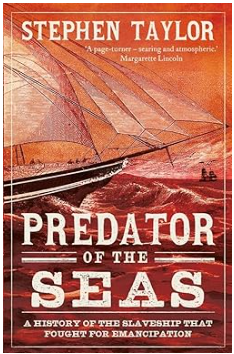
The Predator of the Seas is the dramatic biography of a slaveship turned freedom-fighter – which brings new insights into Britain’s involvement in the end of the trade in enslaved people. HMS Black Joe, ex-slaver turned scourge of the transatlantic trade, is the story of the slave ship sent on a moral crusade. The Brazilian slave ship Henriqueta had no cause for alarm when it spotted the British frigate Sybille early on September 6, 1827, just off the West coast of Africa. Sybille was a sluggish 44-gun warship nearing the end of her lifespan, while Henriqueta was a sleek Baltimore clipper that – if the wind held- would outrun her in no time. Black Joke patrolled the west coast of Africa became the scourge of Spanish and Brazilian slavers, and freed 3, 692 captives from enslavement. The Black Joke became the most famous weapon in the campaign for abolition of slavery.
569 people were held captive below deck, the wind did not help. A two-hour pursuit ensued, and Henriqueta soon fell under the range of Sybille’s 12-pounder guns. With her rigging shredded and he sails in tatters, she was boarded and captured with little or no resistance.
This critical moment arrives half-way through Stephen Taylor’s Predator of the Seas, a triumph for the West Africa Squadron after their hitherto largely frustrated efforts to suppress the transatlantic slave trade at the beginning of the 19th century.
Twenty years had passed since the Slave Trade Act in 1807 formally abolished trade in slaves and permitted the Navy to seize suspected slave ships. The Navy and the Liberated Africans Department, a British Government agency which managed the resettlement of ex-slaves known as “recaptives”, in Freetown, Sierra Leone, had made little headway. How could it compete? The slave trade remained outstandingly lucrative and was thriving in the newly-independent and shamelessly corrupt Brazilian Empire.
William Pennell, the British consul in Brazil, had been keeping a close eye on the Henriqueta and its owner, Jose de Cerqueira Lima. Pennell made a list of the ships’s six “unproved but undoubted illicit voyages” and estimated that the profits totalled “ about Eighty Thousand about £10 million today.
The Navy purchased Henriqueta rather than fall back into Cerqueira Lima’s hands, and renamed it HMS Black Joke after another ex-slaver-turned-privateer during the war of 1812. It was refitted and manned with British tars alongside Liberian sailors known as “KRU” and for its remaining five years of service became a symbol of the abolitionist movement, freeing thousands and helping police the West African coast.
Taylor charts HMS Black Joke’s one of the golden age of sail’s last great campaigns. Focusing on one ship and its changing crew bringing to life the human tragedy of slavery in a way that flatly statistical books rarely achieve.
Britain’s relationship to slavery was, and is, a double-edged sword: popular opinion might have been turning by the early 1800s, but Britain had already made a great deal of money shipping an estimated 3.26 million slaves across the Atlantic. The conditions were unconscionable: hundreds at a time were held chained, immobile, in dark and disease-ridden brigs, dehydrated and malnourished, with no sense of what lay in store for them. William Pitt the Younger told Parliament in 1792: “No nation in Europe had plunged so deeply into this guilt as Great Britain”.
Britain’s interest in limiting the trade was at least in part, led by national security concerns, abolition would constrain the efficiency of plantations in competing empires. British society was also saturated with plantation money, with many powerful political actors having financial stakes, and the emancipation of the 800, 000 enslaved within its own empire would not pass until 1834.From the Brazilian brig Vengador, 645 captives were rescued. When Black Joke’s service ended in 1832, the ship was burned on the shores of Freetown.
Predator of the Seas by Stephen Taylor, Yale UP, £19.99 £25
 The neptune Herald
Leave a comment