
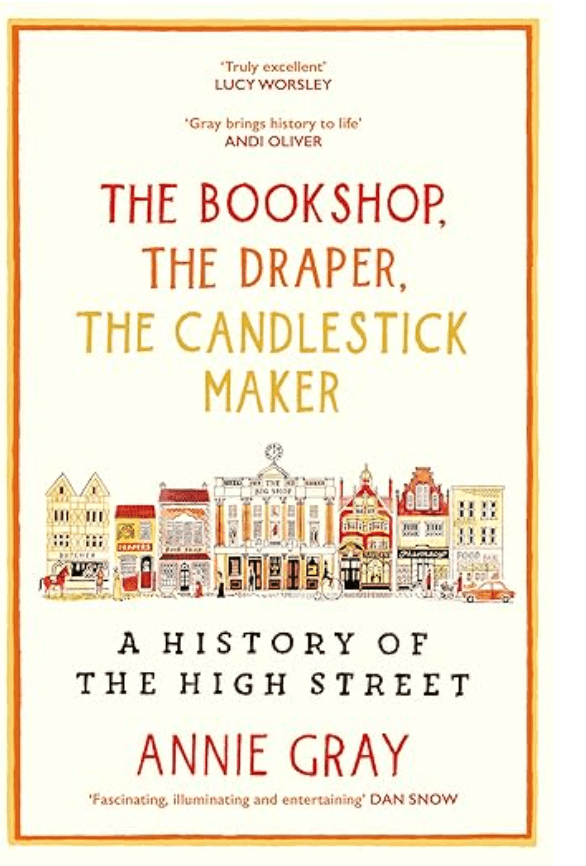
The Bookshop is a history of British Institution in crisis with rich historical vignettes and surprising wares.As spaces where local life and culture unfolds, our high streets can be playgrounds of personal indulgence and community spirit or sites of contentious debate and politicking.
Peeping through the windows of tailors, tearooms and grocers, we explore everything from the toyshops of yesteryears where curiosities were sold for adults not children to the birth of brands we shop at today.
Three-Hundred- years of shopping which takes in sex, snobbery, and moral panics. Josiah Wedgwood has a vision for china, and even better to convert them to selling iconic crockery in the 1770s. Wedgwood laid out his shops with set table, display dressers and comfortable seating. “I need not tell you that it will be to our interest to amuse and divert and please and astonish, nay, even to ravish, the ladies” he explained.
The business model of today’s high-end designers is straight out of his convincing the upper and monied classes that they are there just for them, offering customised goods before selling stuff on the mass market to anyone who can afford it. Wedgwood even offered runs of pottery seconds and self-service.
In this rich lively history of the high street from 1650 to 1965, the historian and broadcaster Annie Gray demonstrates time and time again that there is nothing new under the sun. She rejects our modern doominess about our town centres , with their vape sellers and charity shops.According to Gary The High street is about us, it’s always changing , It began in Medieval markets and the rudiments of life – food cloth and candles, By the 17th century trade had been opened up by the repeal of the sumptuary laws, which had restricted who could buy what according to social class, and the arrival of tobacco, sugars and spices Shops were becoming a thing.
Shopping was a game of wits. Some shops traded an ironmongers, mercers sold silk and velvet, and drapers sold wool – but all were also grocers. Premises were open for at least 12 hours a day. Sell-by dates were long way off. Early recipe book recommended tasting butter cut fresh from the middle of the block, not per cut, and with meat – vegans look away now- the secret was to feel it off the bone, then smell your fingers to tell, if it was off. Butchers were distrusted, their product was expensive and the poorest had meat-free diets out of necessity.
Snobbery made Wedgwood and Thomas Burberry rich men. A Londoner remarked of 18th century industrial Sheffield: “shops all shut, place extremely dull -evidence that the high street had by then evolved far beyond providing the essentials for life, it was about entertainment.
According to Gray, over the century same debates have raged over luxury and necessity , the morality of spending, and how shopping encourages us to be wasteful, rapacious and rude to retail staff, it seems has always had rough time of it from customers. We’ve fretted before about big shops versus small, chains versus independents.
The concept of leisure has always been dangerous, fraught with class tension. The rich could enjoy it, but moral guardians warned when the not-so-rich started enjoying it too, They should be working, not having fun,. Worst of all women, enjoyed it, and indulged in it more and more, who could resist a nice hat? Disapproval of the female sex is the lasting moral panic of the high street,. Inside the shopping extravaganza of the Royal Exchange in London, in its first 1570s incarnation, 45 of the outlets were run by women, as well-turned-out as they could be. This combined with their being perceived as lower status, drove men wild with distaste and desire.
Generations of shop girls were stigmatised as fallen women 0 which fed into more general angst about the link between female consumption and female idleness. There is evidence that the3 high street did attract sex work, alleys near shopping districts were often nick named Gropex and Popkirtle Lane.
The consequences of all this have lingered to the present day women shop workers can often feel disparaged, While women still get jokes made at their expense by their partners for going shopping and buying too many clothes.
Gray writes women should not waste time pawing millinery in saddlers and leather shops, taverns and chophouses, men were free to linger.
Bookshops , a booming trade in the 18th century, were also masculine places and very much not for the working class. By the middle of the century, literacy was 60 per cent among men and 40 per cent among women, Such shops also provided a backroom service in pronography and the sale of STD remedies.
The lack of any public toilets until the late Victorian period was another way of limiting women’s access to the high street. Men might urinate discreetly, respectable women had no choice but to hurry home. That imbalance wasn’t corrected until the 20th century.
Pop-up shops appeared in the 18th century, with traders renting rooms in an inn or market hall, piling them high and selling them cheap, with sandwich men outside 100 years before the term was invented. Confectioner’s shops grew in numbers from the late 1780s to the 1820s. Sugar didn’t come cheap, and the light sweet dainties they sold cakes, jellies, meringue, set creams, syllabus , ice wafers , waffles were associated with wealth and exoticism.
The shops had seating areas, serving hot cakes on white linen tablecloths. Tea caused another high street revolution. By 1784 there were 32, 754 licences to sell tea, one per 234 people, and drinking it was a fresh pursuit, again largely blamed on women, street food, the Greggs of yesteryear, was plentiful biscuits, gingerbread, oysters, plum pudding, pies. Vendors had fixed pitches selling hot drink made from the dried powdered root of Turkish orchids, A hundred years before germ theory, customers handed back the cup for immediate-use.
The high street still belongs to the poor and better-off alike. Gray’s message is to keep faith in it because a community craves a focal point. If we fear online retail, remember that mail order provoked warnings 150 years ago.
 The neptune Herald
Leave a comment