
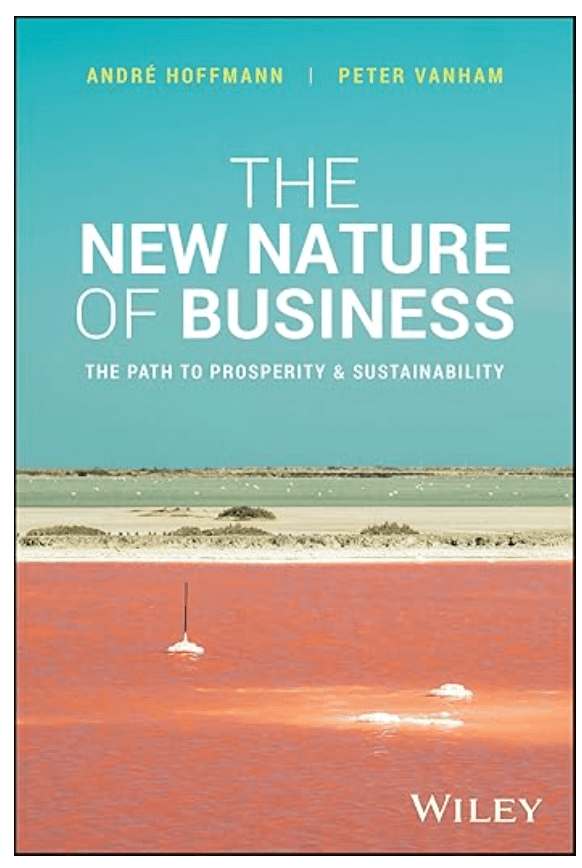
How pioneering business billionaires are resetting their companies’ relationship to nature, society, and our common future creating sustainable prosperity and reveals us how to balance business needs with impact on nature, shareholders with stockholders, and short-term vs Long-term profits. Strategies for addressing the negative externalities and trade-offs that arise from doing business, identifying the right metrics and targets to deliver on your purpose, and accounting for human, social and natural capital, alongside financial capital. A must-read book for business leaders, entrepreneurs, and changemakers at companies around the world.
Luc Hoffman, heir to the Roche Pharmaceutical group shows us how business power can be harnessed to making sustainable, as he choses to raise his family amid the mosquitoes and birds of the wetlands of Camargue on the coast of Southern France.
On one side the world famous nature conservation centres and foundations he established and funded with his fortune, in the second half of the 20th century, and on the other side the Roche empire, built on success of best selling drugs such as Valium and run for growth and profit by professional managers.
The New Nature of Business , Luc’s son Andre, now vice-chair of Roche, and co-author Peter Vanham lay out how to bring these parallel tracks together.
The authors make a case that maximising short-term profit leading to long-term destruction of value. But a narrow focus on carbon emissions could have dangerous unintended consequences.
Hoffmann’s path to the realisation in the early 2000s that the profit making power of business should be harnessed in the quest for sustainability. Twenty-something Hoffman began to pay attention to Roche in the late 1970s , managers regarded the controlling family as “lucky mushrooms” – Glucks[ilze – lacking in business savvy and easily ignored.
Roche founded in 1890s by Hoffmann’s great-grandfather Fritz Hoffmann-La Roche, had already left plenty of scars on the natural world having soiled its own backyard by dumping chemical waste over decades in a pit next to the Rhine, bear Roche’s headquarters. Remember the environmental disasters of the 20th century occurring in Seveso in Italy in 1976, when a plant owned by a Roche subsidiary accidentally spewed toxic dioxin over the town. There was also a vitamin price fixing scandal during the 1990s resulting in multi-million-dollar fines.
Rival Novartis proposed a merger in early 2000s, it woke the out of their torpor. The next generation of the family rallied to keep Roche independent, after establishing new relationship with management and focus on purpose and profitability.
The authors focus on Roche’s transformation with case studies of successful projects to create sustainable and inclusive property at other organisations, including the unlikely greening of listed Swiss cement maker Holcim and the integration of sustainability into the instead business school curriculum.
Hoffman’s ideals also now face challenge from the pushback against “woke” capitalism, which forced Jochen Zeitz, lauded her for the “reinvention” of Harley Davidson, to roll back some of his efforts to make the US motorcycle company more inclusive.
Billionaire Hoffmann writes “ It is not how you spend your money that matters, but how you make it”.
The New Nature of Business: The Path to Prosperity and Sustainability by Andre Hoffmann and Perter Vanham, Wiley £23.99/ $29.95, 256 pages.

 The neptune Herald
Leave a comment