
MacCulloch notes that for the vast majority of people throughout this history, marriage was a “contract between two men” that is between two fathers. And that “When church weddings did start appearing, patchily, in the fourth century, the Church did not offer them to all the faithful”. Three categories of marriage emerged: the “Glorious ( imperial elite) , the “middle” ( imperial officers), and the “vile” (everyone else), with the vast majority of unions in the last category having no involvement from the Church at all. He rebukes contemporary Christians for asserting that there is a “Christian understanding of marriage” with out acknowledging the variety of belief and practice for the whole of Christian history. Interpretation of matters of sex was becoming, tentatively, a conversation that included female voices. Christian liturgists have been more interested in rites for celibacy , given the western Church’s inescapable association between shame and sex. not excluding marital sexuality. Marriage emerged as a way to regularise activity that was, for at least the first 1, 000 years of Christian history considered sinful. The Christian debate is traced right up to the 1960s, when the Archbishop of Canterbury is able to stay, without some confidence “ It seems to me that an enlightened Christian morality does require that we avoid suggesting that sexual sins are necessarily more terrible than others because Christ does not suggest this”.
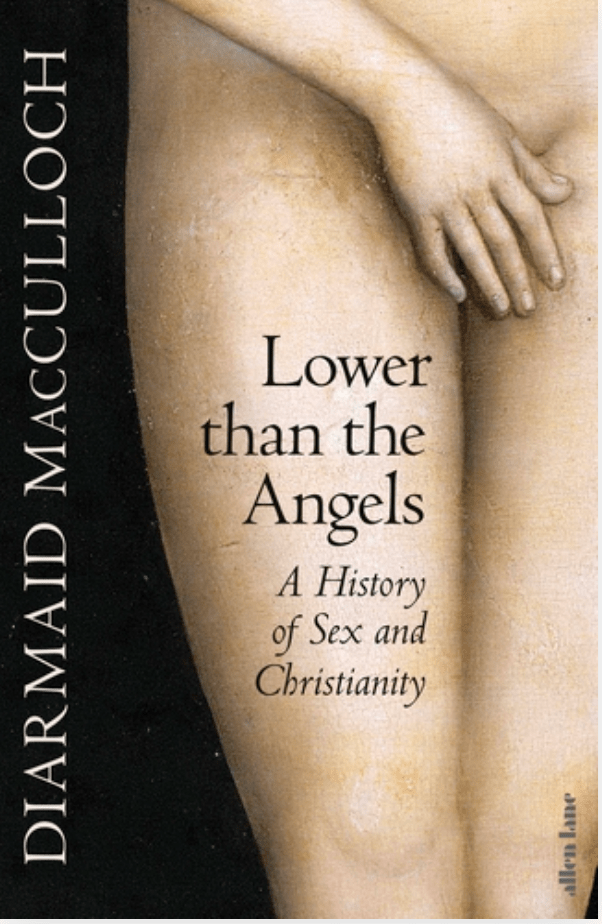
The Bible observes that God made humanity “for a while a little lower than the angels”. If humans are that close to angels, does the difference lie in human are that close to angels, does the difference lie in human sexuality and what we do with it? Much of the political contention and division in societies across the world centres on sexual topics, and one-third of the global population is Christian in background to outlook, in a single lifetime. Christianity or historically Christian societies have witnessed one of the most extraordinary about-turns in attitudes to sex and gender in human history. There have followed revolutions in the place of women in society, a new place for same-sex love amid the spectrum of human emotions and a public exploration of gender and trans identity. For many the new situation has brought exciting liberation- for others, fury and fear. The book seeks to calm fears and encourage understanding through telling a 3000-year-long tale of Christians encountering sex, gender and the family, with noises off from their sacred texts. Lower than the Angels, urges us to pay attention to the sheer glorious complexity and contradictions in the history of Christianity. The reader can decide from the story told here whether there is a single Christian theology of sex, or many contending voices in a symphony that is not at all complete. Oxford’s Emeritus professor of the History of the Church introduces an epic of ordinary and extraordinary Christians trying to make sense of themselves and of humanity’s deepest desires, fears and hopes.
Theological debates begin with belief described by St Anselm in his famous phrase “faith seeking understanding”. For a historian the church bringing together these sometimes contradictory disciplines is an everyday challenge. MacCulloch explains “ treating one’s own culture with the same critical curiosity and detachment that most societies have found easier to exercise in scrutinising other cultures”. Church of England and worldwide Anglican communion, is convulsed by arguments over the blessing of same sex relationships. MacCulloch acknowledges “anyone sitting down to read a history of sex and Christianity in the twenty first century is likely to have one reason or another for being in a rage”.
Lower than the Angels: A History of Sex and Christianity by Diarmaid MacCulloch, Allen Lane £35, 688 pages/Penguin $40, 752 pages.

 The neptune Herald
Leave a comment