
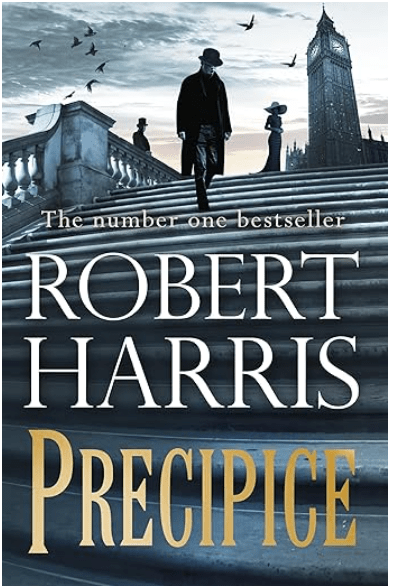
Robert Harris describes a prime minister’s love affair as the first world war looms, summer of 1914, a world on the brink of catastrophe. Imagine how powerful and successful older man can fall in love for a much younger woman, who is flattered and moved by attention. In London, 26-year-old Venetia Stanley – aristocratic, clever, bored, reckless – is having a love affair with none other than the Prime Minister, H.H. Asquith, a man more than twice her age. He writes to her obsessively, sharing the most sensitive matters of state. As Asquith reluctantly leads the country into war with Germany, a young intelligence officer is assigned to investigate a leak of top secret documents- and suddenly what was a sexual intrigue become a matter of national security that will alter the course of political history.
Precipice is the thrilling new novel from Robert Harris who is master of historical fiction who brings to life the recent and ancient past.
Asquith is tired after years in a demanding job, has a difficult wife, and drinks too much. She is dazzled, at least for a bit, by his eminence, although she herself is part of the British aristocracy during that will turn out to be its heyday. The older man finds her enchanting, her mild eccentricities, such as her beloved pet penguin.
When the love affair takes place and who the couple are, as it reaches its peak in the summer of 1914, as Europe slides towards the first world war, and Herbert Henry Asquith, prime minister of Great Britain, the world’s hegemonic power. Venetia Stanley, a daughter of Baron Sheffield, with connections throughout the ruling classes Another lover, whom she eventually marries, is Edwin Montagu, Asquith’s rich and accomplished junior colleague.
Asquith met Stanley at London Parties, or at country houses and exchanged letters when they were apart, the British government was initially preoccupied with a crisis over Ireland. It was not until late June that Asquith’s letters began to mention the more serious crisis looming on the continent and that he talked of the possibility of war.
Many Europeans through they would never see another world war, as Europe was a great continent leading the world in science and industry and even civilisation. Turbulent part of the world drew outside powers into a dangerous confrontation.
Harris makes use of the press and of official documents. The assassination of the heir to the Austrian throne and his wife in Sarajevo on June 28, with the connivance of Serbian nationalists, set off the chain of events that led to the war. Austria was determined to finish Serbia and Germany backed it. Russia supported Serbia and its ally France stood by Russia.
Britain could have made clear to Germany in those last days of peace that it would fight on France’s side and bring all the power of the British Navy to cripple Germany’s economy. Yet the Asquith cabinet was deeply split, and Asquith himself moved only gradually to thinking that Britain ought to intervene, as he was busy his personal love affair. At the start of August, as Germany launched its full scale invasion of neutral Belgium and France, the British found they had little choice but to send ground troops to mainland Europe. Meanwhile Asquith continued to write to Stanley, often during cabinet meeting while his divided ministers tried to decide how to proceed.
By September, as British troops were being pushed back, he told Stanley that General Kitchener, the secretary of state for war, had been sent on a secret mission to see if he could salvage the situation. “ You had better keep it quiet for the time being”. Asquith wrote and added, “ I don’t think you know how much I love you….” He frequently included such details of British policy, as well as actual secret documents. As the war began Asquith’s letters to Stanley multiplied. By 1915, he was often writing twice, even three times, a day. While he repeatedly attested his great love for her, he also begged for replies. His obsessive devotion, and this at a critical time when the war was going badly for the allies, was close to madness, and even she seemed to find it oppressive,
On May 11, 1915, she wrote to him of her engagement to Montagu. “ As you know well”, Asquith replied, “ this breaks my heart.”
Their correspondence came to an end but he found consolation in now writing voluminous letters to Stanley’s sister Sylvia.
Precipice by Robert Harris, Hutchinson Heinmann £22, 464 pages.

 The neptune Herald
Leave a comment