
Capitalist elite runs corporation as a business that uses its accumulated wealth to own the means of production and exercise economic power. In the twenty-first century, our most desired goods and services aren’t stacked in warehouses or on container ships, they appear on your screen, fit in your pocket or occupy your head. Although, we consume more than ever before, big business faces now faces a crisis of legitimacy. The pharmaceutical industry creates life-saving vaccines but has lost the trust of the public. The widening pay gap between executives and employees is destabilising our societies. Facebook and google have more customers than any companies in history but are widely reviled.
Economist and former Financial Times columnist, John Kay, reveals how in the pursuit of shareholder value has destroyed some of the leading companies of the twentieth century, incisive and provocative, as The Corporation in the 21st Century, redefines successful commercial activity and leadership, the knowledge economy and what the future of the modern corporation might be.
Last quarter of the 20th century’s shareholder value in which incentivised business leaders relentlessly drove short-term profits to boost share prices. Economy brought in a younger, cooler crowd of business leaders just at the crack of the millennium. Using the decline of former corporate icons such as GE, ICI and Deutsche Bank as prime examples, Kay’s message revealing how financialisation works better for the financiers than the financed and that, taken to extremes, shareholder value was indeed the critical for Jack Welch, GE’s former CEO but discredited and softened by wider stakeholder concerns, shareholder value remains influential in several boardrooms.
New economy companies like Apple, Meta and Alphabet, relays on intellectual rather than financial capital, redefined management, by incorporating collaboration, involving employees in decision-making and a shared sense of purpose. Outsourcing and the purchase of specialist services replaced in-house self-sufficiency, problem solving replaced lean production as the principal competitive weapon, with softer management approach with social as well as commercial consequences.
Interplay of these new waves led to the paradox that customers love the products but hate the producers. Despite offering innovative products and services, global business has lost the trust of the public. According to Kay “as a result of erosion of business ethics and the evidence of indefensible inequalities, the twenty-first-century corporation fac3es a crisis of legitimacy”. When capital-intensive plant and machinery were the means of production, the capitalist elite had permanent power over the workers, now the control resides with professional managers who derive power not from ownership or accumulated wealth but from their transient role in the business.
Kay believes we need look into the changed relationship between soft intellectual and hard financial capital. Profit should not longer seen as a return on financial capital but as a economic rent. Kay names a barrister in poor health who “retired early to study history at Oxford but lived long enough to see the havoc which he had helped cause”.
Kay hardly mentions the fact of artificial intelligence.
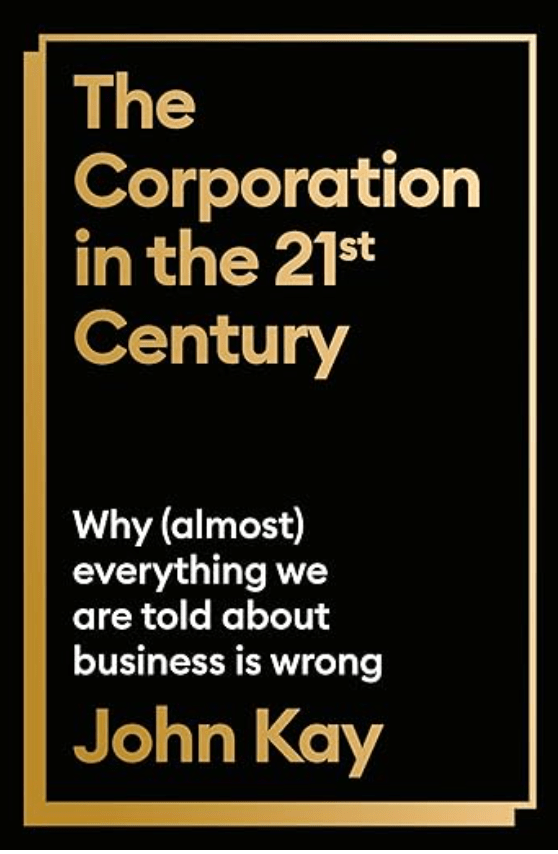
The Corporation in the 21st Century: Why (Almost) Everything We Are Told About Business Is Wrong by John Kay, Profile Books £25, 448 pages.
 The neptune Herald
Leave a comment