
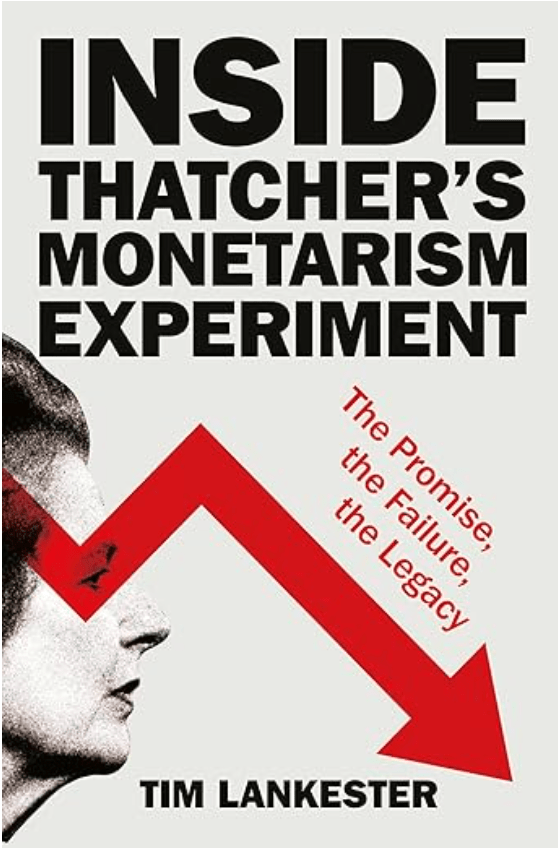
In 1979, Margaret Thatcher was elected to Downing Street with rampant double-digit inflation, rising unemployment and flatlining economic growth. Her grocery experience and monetarist orthodoxy held the control of money supply by rejecting the old orthodoxies and was promoted by only a minority of economists’ policy based on the doctrine of monetarism. Tim Lancaster, was the private secretary for economic affairs to Thatcher during the early years of her government, and gives an insider’s account explains her attitudes and decisions and those of the other main players in this deeply damaging experiment in economic policy making, which promised much but completely failed to deliver. Offering fascinating insights into one of the most unsuccessful episodes of British economic history.
By the time inflation was under control unemployment had doubled to more than 10 per cent, with over three million on the dole, where it stayed for most of 1980s. British economic history highlights the steepest recession since the 1930s saw manufacturing collapse and shift to China, losing a quarter of its workforce, because of macroeconomic bungles, from the return to the Gold Standard in 1925 up to Conservative party’s Liz Truss’s tragicomic 49 days in power in 2022. It’s strange that Thatcher’s first two years , when she pursued her monetarist philosophy with the greatest determination. Thatcher’s refusal to heed her critics a blue print for principled leadership against the wet bleating of the establishment “Blob” and her refusal to change course reversed decades of unmanaged decline.
The theory of Monetarism in economics equates MV=PY where p, is the price level multiplied by Y, real gross domestic product, is equal to money in circulation, M multiplied by how fast it circulates V. If the prices are out control then the monetarist prescription is to limit the growth of M, the money supply, Monetary growth soared far above target, as the economy drove into recession prompting government to deflate the economy even further through tight budgets and higher interest rates. Lancaster forensically teased out the unknowns hidden within that simple equation, The Conservatives took over from a Labour government overpowered by union bosses: One told the Prime Minister “It’s your job, Jim Callaghan, to get inflation down to 2 per cent; It’s my job to get 18 per cent for my members”.
Lancaster highlights emerging most from this account is how central was Thatcher’s own dogmatism to the debacle. Without being remotely qualified, she was determined that money supply drove the economy rather than the other way round, She mistook genuine uncertain ty for ideological weakness. When she eventually abandoned direct involvement in monetary affairs, the ministers, like Chancellor Nigel Lawson – who took over were much more pragmatic.
Is it a wonder Lankester’s merely took a ringside seat to the debacle.
Inside Thatcher’s Monetarism Experiment: The Promise, the Failure, the Legacy by Tim Lankester, Policy Press £19.99, 228 pages.
 The neptune Herald
Leave a comment