
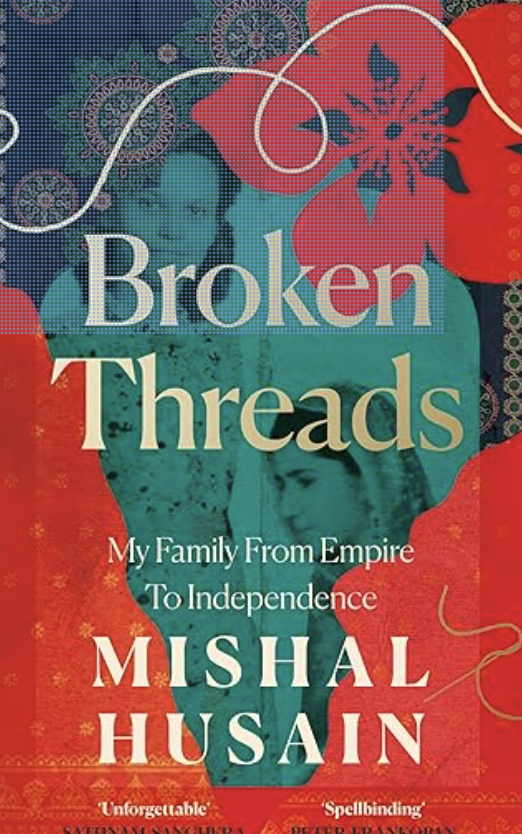
Acclaimed BBC newsreader and journalist Mishal Husain, reveals the transformation of her grandparents’ lives amidst empire, political upheaval and partition, as we;; as a chronicle of one of the most cataclysmic events in South Asia. “I witnessed the dwindling glow of the British Empire. I saw small men entrusted with great jobs, playing with destiny of millions’.
Mary Quinn, a student nurse and devout Catholic married for love & Mumtaz Husain was he only son of extremely conservative Muslims. In early 1942 they quietly arranged consecutive weddings : one performed by an Imam in Lahore, who reasoned that even the Prophet had a Christian wife, and the second by an Irish priest who decided to sort it all out, inviting a chorous of nuns to add to the fun like Sister Act. Their parents were not delighted but no blood was spilled.
These two became paternal grandparents of Mishal Husain , whose family memoir spans much of the turbulent history of the Indian subcontinent during the 20th century. For Mumtaz, Mary was always “ the anchor and focus of my life”.
Distraught after her death, he wrote a memoir, a tribute to “a person who stood by me through a turbulent life like a rock of stability and faith”. The lives of Mishal Husain’s grandparents changed forever in 1947, as the new nation states of India and Pakistan were born. For years she had a partial story, a patchwork of memories, and anecdotes, hurried departures, lucky escapes from violence and homes never seen again. Decades later, the fragment of an old sari sent Mishal on a journey through time, using letters, diaries, memoirs and audio tapes to trace four lives shaped by the Raj, a World War, independence and partition.
Mumtax rejects the marriage arranged for him as he forges a life with Mary, while Tahirah and Shahid watch the politics of pre-partition Delhi unfold at close quarters. As freedom comes, bonds fray and communities are divided, leaving two couples to forge new identities, while never forgetting the shred heritage of the past.
Mishal Husain’s maternal grandparents, Shahid and Tahirah Hamid, faced no such obstacles – both being Muslim and from similar backgrounds. Shahid, a Sandhurst-educated army officer, proposed to Tahirah on the night they met early in 1940; they married later that year, to the satisfaction of all concerned. Shahid, writer and chronicler, became the personal secretary and eventually close friend of Claude Auchinleck, a war hero and the last Commander-in Chief of the pre-Independence Indian army. Tahirah became a central figure in the life of her granddaughter, who went every summer on holiday from her English boarding school to stay in the family home in Rawalpindi, a house buzzing with aunts, uncles, cousins an stories. When she too was widowed , Tahirah began to write a memoir, but it petered out, only to be contained in audio form, on tapes: a third grandparent to leave behind an invaluable first-hand account of a tumultuous period.
Broken Threads: My Family From Empire to Independence by Mishal Husain, Fourth Estate £18.99, 336 p
 The neptune Herald
Leave a comment