
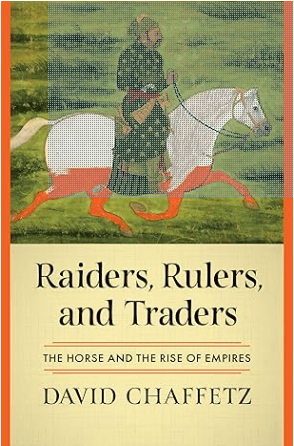
No animal is so entangled in human history s at the horse. Horse had a central role in culture, commerce and conquest when delve into the history of civilisation. Domestication of horses, followed by the advent of riding, powered mighty empires Persian, Mongol, Mughal spanning Iran, Turkey, Afghanistan, China, India, Russia. The deep and ancient bond between humans and their horses connected a vast continent, forged trade routes, linked cultures and fuelled war machines.
David Chaffetz, a scholar of history, tells the story of the steppe raiders, rulers and traders who amassed power and wealth on horseback from the Bronze Age through the twentieth century.
Chaffetz presents new view of what has been known as the “Silk Road”, and a lively history of the great horse empires that shaped civilisation.
Empire have depended on the supply and deployment of horses. Two Thousand years ago, Ma Yuan, a general of China’s Han Dynasty told his emperor that “Horses are the foundation of military power, the great resources of the state and warned that if the power of the horse is allowed to falter, the state will totter to a fall”.
In the 17th century, the Mughal general Firuz Tang was saying much the same, declaring that without the horse “no sovereignty could be erected, no countries sounded nor no mighty monarch reign”.
Horses have been central to the rise and fall of civilisations. To achieve that the need for breeding horses in sufficient numbers and their training to pull chariots and when the breeds were large enough – to carry warriors into battle.
World today is unaware of this past importance of the horse. The ravages of steppe-based empires that competed for domination in the rest of Eurasia and reached as far as Kyiv and Moscow. Much of mountainous Greece, was unsuitable for cavalry, leaving Persians vulnerable to Greek sea power. This contributed to the rise of the global oil economy and motorised transport so suddenly and completely eclipsed horses in the 20th century.
In prehistoric times, the horse was a small shy animal hunted by humans for food and later domesticated long after dogs and sheep for its meat and for mare’s milk. The horses needed pasture and the herders learnt too ride them so they could keep up with the animals, giving rise to great steppe forces such as Scythians, the Huns, and the Mongols, who once ruled the largest land empire in history.
Horses are social animals that typically develop close bonds with their riders making them ideal mounts for warriors in dangerous battles. In the Chariot era, Homer’s Trojan hero Hector was “rich in horses” and “tamer of horses”.Mongol emperor Genghis Khan was buried with his favourite yellow steed. Sedentary empires notably China, fought steppe horse breeders and their equine expertise and traded with them over the centuries -with horses being the most important item of exchange. Chaffetz suggests the Silk Road should really be called the Horse Road, because horses were the true strategic commodity of the time. The reason why this was named Silk Road is because most of those who described the journeys were diplomats bearing luxury goods, not the merchants doing the bulk of the trade. Even China’s tea exports were developed to pay of the import of horses when the supplies of silk proved insufficient. The Portuguese in India made most of the wealth for their Goa colony from horses, which they imported in bulk from the Gulf in specially designed ships.
Horses are larger component of trade by value on the Silk Road in terms both the high prices paid for them and the quantity of horses purchased especially in times of war according to Chaffetz.
“The horse trade united the peoples of Eurasia in a vast market for livestock. Herders and aristocrats from one end of Asia to the other had shared the cult of the horse.
Riders, Rulers, and Traders: The Horse and the Rise of Empire by David Chaffetz, WW Norton £25/$32.50. 448 pages.

 The neptune Herald
Leave a comment