
The English sucked up to the Mughal emperors, sending ambassador after ambassador. The first Englishman in India was not a coloniser or civiliser, but a Catholic refugee. A Wiltshire native and Wykehamist, Thomas Stephens decided to join the Jesuits in Goa having fallen in with a disreputable crowd at Oxford. He threw himself into the urgent task of harvesting souls for Christ. Stephens’s friend Father Pietro Berno personally set fire to a temple in Cuncolim and publicly slaughtered a cow, an animal sacred to Hindus. The locals proceeded to kill him and mutilate his body.
Stephens authored a catechism in the Konkani language and an epic poem of 11, 018 strophes in the Marathi language , the Kristapurana or Story of Christ. Stephen spent over forty years in India. Other Englishman travelling east were guided by different motivations. Thomas Coryate, who started off as James I’s jester, was arguably England’s first tourist in India, given to trolling Muslims en route to the mosque with a harangue that began “ La Allah Illa Allah, Hazarat Isa Bin Allah”. There is no God but God, Christ is the Son of God”. Luckily for him the Mughals dismissed this as a lunacy, not heresy, which in its homeland would have warranted cracking open the torture rack.
William Hawkins went to India to make his fortune. The naval nepo baby, whose uncle had been one of the pioneers of the global slave trade, arrived in Surat on an East India company vessel in 1608. Then he ferried to the Mughal capital of Agra, he presented the amused emperor Jahangir surrounded by eunuchs fanning him with peacock fathers, with a trade deal. Although Hawkins did not get the agreement he was hankering for, but Jahangir elevated him to the minor nobility. As a Khan Hawkins was given a decent stipend four hundred cavalrymen and a Christian wife, since he could not countenance relations with “a Moor”. Three years later, when his sozzled compatriots caused a drunken spectacle in the coastal city of Surat, Hawkins was disgraced by association. When he attempted to calm nerves in court, he shuffled in smelling like a mini0bar, Jahangir himself was known to drink like a fish, but it so happened that he had forsworn alcohol that year, going so far as to ban the presence of drunk courtiers to ward off temptations. When the company trader outbid the queen mother, Maryam al-Zamani, for a supply of indigo. She happened to be one of Mughal India’s foremost shipping magnates, Jahangir stripped Hawkins of his title, his allowances and his access to the court. Defeated Hawkins left India and died in high seas. Maryam Khan, his Indian Christian wife , arrived in England a widow, she sued the company for compensation, and hooked up with Gabriel Towerson an old crony of Hawkins.
Lubaaba Al-Azami, a lecturer at the University of Manchester, has assembled in her fresco of the itinerant English chancers who passed through 17th –century India. These were the encounters before the age of the Empire, she remind us, which is to say they emphatically did not go to India with the purpose of one day ruling it. They were in the business of earning and learning. Few of them were Erasmus students of their day, driven by an appetite for linguistic, sexual and cultural conquests. She describes 17th-century England as a “dank and diseased, underdeveloped island of nation.”. England’s GDP per capita was large again as India’s in 1600. The English peasant was much better off than his Indian counterpart, who, as the Indian historian Irfan Habib has show, eked out a miserable existence in one of the most extractive regimes on Earth. It was no accident that it was the English who bent over backwards to secure a trade sending ambassador after ambassador to suck up to the emperor, but the Mughals couldn’t be bothered with sending a counterpart to London. The East India Company ultimately supplanted the Mughals in the subcontinent, it was built on war, slavery and corruption according Al-Azami.
The tale of the baronets and bayonets , battles and backhanders. She shows how the Company was saved from financial ruin by its takeover of the Guinea Company in 1657. In good time Company men were to be found trafficking West African and Indian slaves across the Indian and Atlantic Oceans among them lusty, young and perfect Hindu women who were spirited away to St Helena, where they presumably worked as prostitutes. Sponger Josiah Child, who twice married wealthy widows for their fortunes, which enabled him to become the Company’s largest shareholder. He greased the palm of Charles II with an annual bribe of 10, 000 Guineas in the 1680s, then stupidly provoked a war with the Mughals in 1686, resulting in the Company was sent packing. After ousting it from Bengal in the West the Mughal army trekked east to lay a siege to Bombay, whose governor, John Child had seized a Mughal fleet, known as Child’s war resulting in humiliating defeat, with John Child Surrendering to Alamgir I, “hands nund, bowing penitently at the foot of his throne”. Big battles followed in the 18th century and towards the end in 1783, Horace Walpole could write with some justice that “no man ever went to the East Indies with good intentions”.
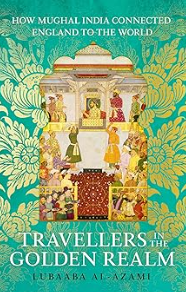
Travellers in the Golden Realm: How Mughal India Connected England to the World by Lubaaba Al-Azami, John Murray £25, 320 pages.

 The neptune Herald
Leave a comment