
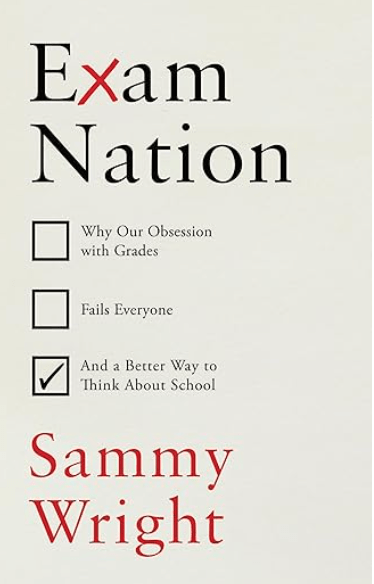
Drawing on twenty years as teacher, hundreds of interviews, experience on the UK Government’s Social Mobility Commission, head teacher Sammy Wright exposes the fundamental misconception at the heart of our education system. Focussing on the grades pupils get in neatly siloed, academic subjects, we simply end up ranking them and our schools into winners and losers: some pupils are set on a trajectory to university- the rest are left ill-equipped for the world they actually face.
Wright shows that schools are- and should be- so much more than this. With wisdom and humour, balancing idealism and pragmatism, he sets out what a better way would look like and how we might get there. A report from the front line of schooling that show how British education has become swamped by the cult of the exam. School system is failing the remainder of the students who don’t make the grade.
Sam Wright, himself an interesting cohort: high flyers who have gone into teaching in state schools and emerged from the classroom with a compelling story to tell. A self-confessed nerdy kid, Wright won the scholarship to a private secondary school and after studying English at Oxford, went into teaching. He was not attracted to moving on to consultancy, politics or journalism after a short spell in the classroom. Over a 20-year career, he has taught in London, Oxfordshire, and now in Sunderland, north-east England, where he heads a large comprehensive secondary school. His first novel Fit- a rags to riches tale set in deprived town – won the Northern Book Prize in 2020. He also sat as a member of the Social Mobility Commission, an experience that left him frustrated by government inactions on poverty and eventually sceptical of the commission’s own purposes. In Exam Nation, he wants everyone to understand how our system really works – or rather, about the many ways in which it doesn’t.
The English education system is still considered contested territory. In the finals years of the Conservative government, ministers trumpeted the success of the so-called “Gove revolution” in particular its sweeping reform of the governance of schools, the curriculum and exam system. They even pointed to a rise in results, in some subjects among English students, in the 2022 Pisa international league tables, it was rarely pointed out that a third of all schools refused to take part, with one subsequent investigation suggesting higher-performing schools were therefore over represented in the sample.
But in the world of English education – the UK’s devolved nations differ in their approach to schooling -metrics have become everything: performance tables, “Ebacc” and “progress 8” have governed the rankings. We are constantly reminded that exam success is ever more crucial for today’s adolescents, with little attention is paid to what has been described and decried by school and college leaders, as the “forgotten third”: those young people who don’t and won’t ever make the grade.
Wright explains his shock and fury at the exam shenanigans at the height of the pandemic, when the government’s decision artificially to fix the distribution of grades largely penalised schools in poorer areas. He taken on the flawed political discourse that has shaped our education, particularly “ this intense Meritocratic system designed around the idea that competition is the thing that make us better … the need to be in some kind of Darwin struggle to make us stronger. The gap in attainment – grades gained between students who grow up in poverty and those who don’t has not shifted during the past 15 years of structural upheaval.
Exams are necessary way to test mastery of many forms of knowledge: we just have too many of them, at least in England. More insidiously the exam results and rankings are now used to pit school against each other, forced to use the tools at their disposal (principally admission policies) to ensure a more favourable , usually middle-class intake, leading to better results, better judgements from the education watchdog Ousted and high, sometimes unwarranted , praise.
The system is biased against those who come from disadvantaged backgrounds. Those with obvious academic ability will get through, for others, a particular teacher, subject or inspiring lessons might prove transformative. For too many, that movement of transformation never comes. Through a series of sensitive e, tender pen portraits and interview with pupils around the country, Wright reveals a form of stubborn low-level disengagement on their part, a conviction that education, as currently designed , is not for them: an attitude now fuelling the alarming rise in absentee rates, particularly since the pandemic.
According to Wright, education cannot be treated as a market, its is public good and schools are vital heart of the communities, not vehicles for individual economic advancement, and as long as we have the current system we are wasting the potential of the long school years- and our nation’s young. With changes to admissions and inspections, reform of GCSE’s and more freedom and flexibility in the curriculum, more students could enjoy their education and more teachers enjoy teaching.
Recent decades of government encouraged misrepresentation and marginalisation.
Exams, grades, league tables, Ousted reports, all of them miss the point of school and together they are undermining out whole approach to education.
Exam Nation: Why Our Obsession with Grades Fails Everyone by Sammy Wright, Bodley Head £22, 288 pages

 The neptune Herald
Leave a comment