
Raj M Shah, a 27-year-old US Airforce Captain, on a patrol in 2006, was flying an F-16 fighter jet near Iraq’s border with Iran when he realised that he did not know which side of the border he was on, as he lost sense of direction. That was a serious problem, entering Iranian airspace could cause an international incident, worse still he might be shot down. Although the $30million F-16 was among the world’s most advanced jets, its navigation system could not graphically pinpoint his location on a moving map. Shah back at base, figured out a simple hack, by loading a handheld device that he used for emails with civilian navigation software. The next time he flew a mission, Shah strapped the $300 gadget did a better job than the sophisticated navigation systems of the F-16, and realised first time how far Silicon Valley had outpaced traditional US defence companies when it came to developing new technologies, especially software.
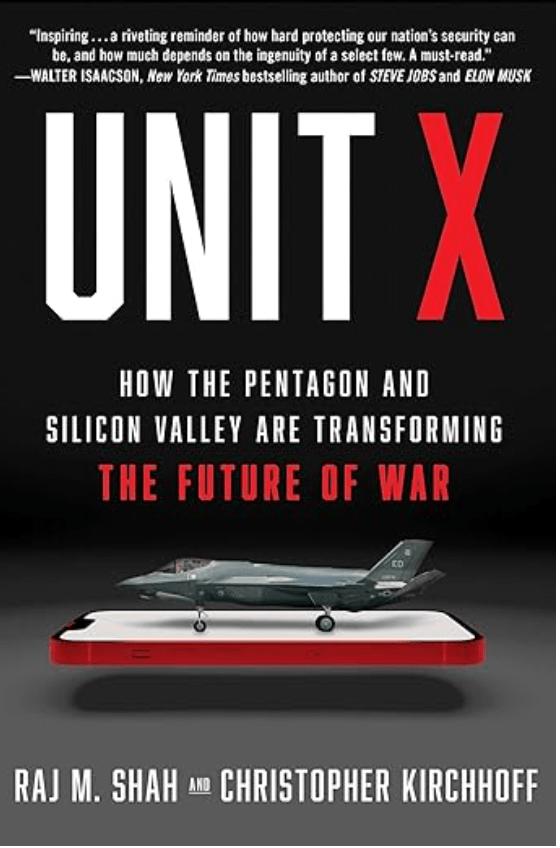
Unit X is an elite unit within the Pentagon – the defence Innovation Unit, whose mission is to bring Silicon Valley’s cutting edge technology to America’s military. Shah and Kirchhoff, gives a detailed account of how the US defence industrial complex has started to come up to a technological speed by tapping Silicon Valley. The story begins in 2015, when the the US secretary of defence Ash Carter set up a Pentagon-backed venture capital fund called Defence Innovation Unit Experimental, or DIUx, to deliver commercial innovation to US war-fighters. That mission was ostensibly simple. The War in Ukraine has since shown the world how even commonplace technologies such as smartphones and drones can transform a battlefield. Shah left the air force to become a tech entrepreneur, and Kirchhoff, a former lead strategist for technology at the National Security Council, were tasked to head DIUx, they quickly realised how difficult their job would be. They struggled to overcome the bureaucratic “antibodies”, vestee interests and pervasive mistrust between Silicon Valley and the Pentagon. The US had maintained battlefield superiority by fielding better technology than anybody else. The US spent billions on weapon systems like F-16s with no moving maps, rivals such as Russia, increasingly developed their technologies at a fraction of the cost, often using off-the shelf components churned out in China or Taiwan, for rough and ready result.
“Civilian in 2016, use smartphones to summon taxis, pay bills, US forces were often running software programs older than the officers using them”, writes Shah and Kirchhoff. They also visited Al Udeid US air base in Qatar and saw thousands of mid-air refuelling flights organised using second world war technology: Service personnel who moved paddles around a giant map. The authors realised that to get the military to actually buy Silicon Valley technology and introduce it to the battlefield, “We had to back the Pentagon itself”.
The autonomous drones AI-powered systems, cryptographic software and surveillance satellites that DIUx subsequently helped fund and develop, by leveraging state money with private capital, are wonderful and appalling. Would you be terrified by the prospect of swarming drones, but also be impressed by an app, developed for $1.5 million, that saves an estimated 25 million gallons of fuel every year?
UnitX emphasises the need of the US and the west to maintain technological parity with its adversaries and so deter war.
The book finishes in Ukraine’s Kyiv’s western-backed forces fighting the kind of war that DIUx originally envisaged when it was set up almost a decade ago, Ukraine’s forces although outgunned and outmanned had stood their ground in large part thanks to the quick adoption of rapidly developed commercial technology, some of its fostered by DIUx.
A vast and largely unseen transformation of how war is fought as profound as the invention of gunpowder or advent of the nuclear age is occurring. Flying cars that can land like helicopters, artificial intelligence-powered drones that can fly into buildings and map their interiors, micro-satellites that cab see through clouds and monitor rogue missile sites – all these are more are becoming part of America’s DIU-fast-tracked arsenal.
Until bow, the Pentagon was known for its uncomfortable relationship with Silicon Valley and for slow-moving processes that acted as a brake on innovation. Unit X was specifically designed as a bridge to Valley technologists that would accelerate bringing state of the art software and hardware to the battle space. The Unit were tasked particularly with meeting immediate military needs with technology from Valley startups rather than from so-called “primes” -behemoth companies like Lockheed, Raytheon, and Boeing.Today, it is an urgent necessity to strengthen the relationship between Washington and Silicon Valley amid China ordering all commercial firms within its borders to make their research and technology available for military exploitation.
Taking us inside AI labs, drone workshops, and battle command centres – and also overseas to Ukraine’s frontlines – Shah and Kirchhoff paint a fascinating picture of what it takes to stay dominant in fast-changing and often precarious geopolitical landscape.
Unit X: How the Pentagon and Silicon Valley Are Transforming the Future of War by Raj M Shah and Christopher Kirchhoff, Simon & Schuster £20, 336 pages.
 The neptune Herald
Leave a comment