
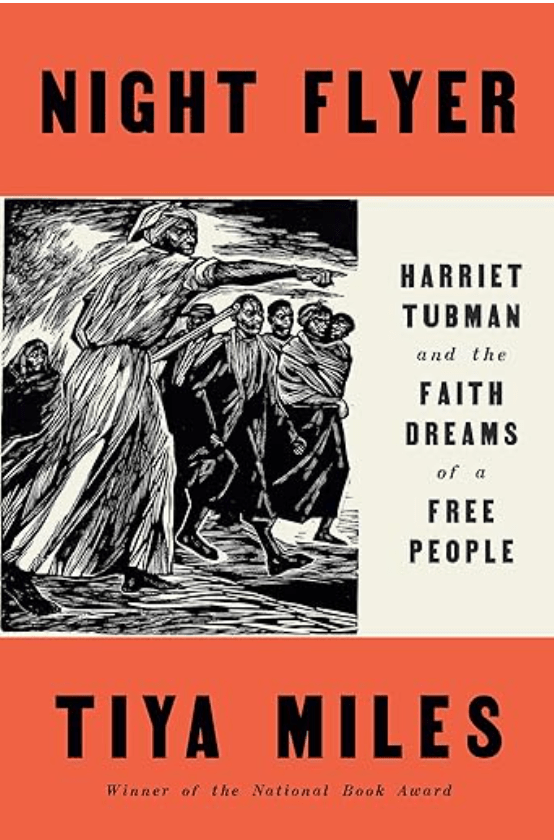
Tina Miles, a National Book Award-winning author of All That She Carried, acknowledges in her fascinating new book Night Flyer, Harriet Tubman is the subject of several excellent modern biographies, most notably by Kate Clifford Larson and Catherine Clinton. Tubman’s first official “as told to” biography was published as early as 1869 and was written by Sarah Bradford, one of several white abolitionist women who supported Tubman in her work. Tina Miles explains intimately and revelatory reckoning with the myth and the truth behind an American everyone knows and few really understand.
Harry Tubman, five feet tall, unable to read, and suffering from a brain injury, who managed to escape from her own enslavement, return again and again to lead others north to freedom without loss of life, speak out powerfully against slavery, is among the most famous Americans ever born and soon to be the face of the twenty-dollar bill. Yet often she’s a figure more out of myth than history, almost a comic-book superhero.
Two centuries have passed since her birth, the circumstances of childhood and adolescence of Araminta Green-Ross remain shocking, perhaps all the more so for how common they ere in that time and place. Born into enslavement in Maryland in around 1822, “Minty” was left to fend for herself while her parents were forced to work for those who claimed to own them. Aged about six, she was “rented” without warning or explanation, to a neighbouring overseer to mind a baby, ignorant of what was required. “Minty would learn, like other enslaved children, that the teaching tools of slavery’s class room were the whip, or stick or rod”.
However, Minty was not broken by this unimaginably harsh treatment, not even when, as a teenager, her skull was cracked by a blow to the head intended for an enslaved boy she was trying to protect. The injury would cause life long neurological impairment – probably temporal lone epilepsy. She is more determined to remedy the unfathomable injustice to which she and millions of others were subjected. She would be known by her mother’s name – Harriet_ and by the last name of her first husband John Tubman.
Harriet Tubman was called “Moses” by the dozens she led to freedom at great personal cost. Her own escape in 1849, to Philadelphia, then to Canada, was miraculous enough- yet she would return again and again to guide others through the wilderness to freedom. She became the first American woman in history to lead a military raid, freeing some seven hundred people. You could almost say she’s America’s Robin Hood, a miraculous vision, often rightly celebrated but seldom understood.
Miles explores with her characteristic tenderness and imaginative genius, beyond the stock historical grid to weave Tubman’s life into the fabric of her world and probes the ecological reality of Tubman’s surroundings and examines her kinship with other enslaved women who similarly passed through a spiritual wilderness and recorded those travels in profound and moving memoirs. Harriet Tubman’s mysticism becomes more palpable the more we understand it- a story that offers powerful inspiration for our own time of troubles. She traversed many boundaries, inner and outer.
She was also an effective spy for the United States during the American civil war and the first woman to play a leadership role in an armed raid by the US military. In her later years, she lived until 1913 – she built a remarkable community in Auburn, New York State, offering shelter to the ill, the elderly, the infirm. Her home there still stands, today there is a Harriet Tubman Underground Railroad State Park and visitor centre in her native Maryland. She is due to replace Andrew Jackson on the $20 bill.
Miles is a professor of history at Harvard University and the recipient in 2011, of a MacArthur Fellowship ( sometimes called the “genius grant”.
Miles is clear about the danger that lurk in conjuring the trope of the magical Negro, the singular Black saviour set outside place and time. She wishes to present a flesh and blood woman of her antebellum age and demonstrate how her perilous life offers profound lesson for the 21st century.
Tubman’s own escape to freedom was enough, she fourth the war wrong that enslaved her family and her people. “ I would make a home for them in the North, and the Lord helping me would bring them all there”. Tubman is a “startling spiritual and eerily smart, a guru for her time and ours” not magical but ferociously determined and astonishingly brave.
Night Flyer: Harriet Tubman and the Faith Dreams of a Free People by Tina Miles, Penguin Press, £23.95/$30, 336 pages

 The neptune Herald
Leave a comment