
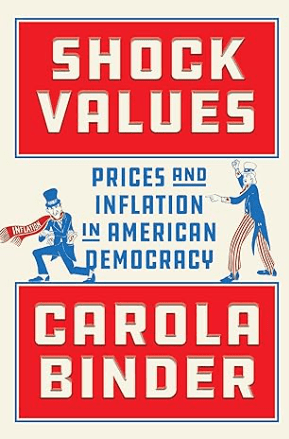
Shock Value tells the untold story of prices and price stabilisation in the United States, many foundational moments in American economic history – the establishment of paper money, wartime price controls, the rise of the modern Federal Reserve- occurred during financial panics as prices either inflated or deflated sharply. The government’s decisions in these moments, intended to control price fluctuations, have produced both lasting effects and some of the most contentious debates in the American’s history.
Shock Values reveals how the American state and been shaped by a massive, ever-evolving effort to insulate its economy from the real and perceived dangers of price fluctuations. With each price instability, the United States has been reinvented not as more perfect union, but as a reflection of its most recent failures, legal battles, economic ideas that have shaped a nation from the dawn of republic to the present.
Arthur Burns, former chair of the Federal Reserve Board of Governors, addressed a gathering of the world’s top economic officials in Belgrade on 30th September1979, discussing “the anguish of central banking”, explaining why inflation had taken hold and why it would probably persist. Central Bankers he argued , had been unable to eradicate inflation because of political and social forces favouring full employment at the expense of stable prices. In such a world, even if central bankers knew that more needed to be done, monetary policy could contribute “only marginally: to reducing inflation.
His diagnosis must have unsettled many in the room, perhaps double-digit inflation would never end.
But Paul Volcker, the new Fed chair who arrived late listened to his predecessor’s lament, and determined to break the inflationary fever, Volcker would soon prove Burns was wrong. Less than a week later, on Saturday October 6, Volcker announced sweeping anti-inflationary measures, was inflection point, unleashing an unprecedented tightening of monetary policy that, after two recessions and much political blowback, finally subdued inflation. Central banks could bring about price stability after all.
But according to Burns, Inflation and politics are intertwined. One look the current circus in Washington surrounding inflation makes this plain. Interaction between the two has a long history. Economist Carol binder argues in Shock Values, fluctuations in price have “shaped American democracy since its very beginning”, influencing the size, structure and scope of government. When price change, some people do better and some worse. If the price of wheat increases, the farmer is happy while the consumer must pay more for bread. If prices increase broadly, the debtor is happy while the creditor must accept devalued dollars. Price fluctuations also put pressure on the government to intervene for higher prices or lower ones, more inflation or less.
What counts as money, how much should there be, who decides Binder skilfully traces in Shock Value, America’s circuitous path from a gold and silver standard to flat currency, as well as the nation’s recurrent battles over centralised monetary power, from Andrew Jackson’s war on the Second Bank of the United States in 1832 to calls for ending the Fed today.
Tariff disputes in the 1830s became so vicious that South Carolina threatened to secede.
In August 1971, Republican President, Richard Nixon – a man with visceral hatred for controls born from his experience implementing them as a government lawyer during the second world war – imposed a three-month freeze on wages and prices, followed by a bewildering assortment of rules and regulations. Nixon’s controls ultimately failed, and inflation worsened until Volcker took charge. While holding prices down by administrative fiat might limit measured inflation for a while, it introduces crushing distortions, the queues at gas stations of the 1970s were only the most notorious byproduct of this misguided policy.
Fifty years after Nixon’s gambit, inflation is once again a problem, but policymakers seem to have learnt from the past. Central banks must act, and alter a slow start, they have, bringing inflation down rapidly. Jay Powell the current Fed chair, understands what is at stake. Fed has not yet won the battle, and may soon face unprecedented political interference should the White House get a new occupant,
Shock Values: Prices and Inflation in American Democracy by Carola Binder, University of Chicago Press $35, 352 pages.

 The neptune Herald
Leave a comment