
Boeing has launched its Starliner capsule towards the International Space Station (ISS) with two NASA astronauts abroad, as the it’s for the first time the vehicle has been entrusted to carry people. Strainer is scheduled to dock with the space station on Thursday. The capsule went up from Cape Canaveral Space Force Station in Florida, riding a United Launch Alliance Atlas rocket. The 12-minute powered ascent was indeed flawless. Commander Butch Wilmore and Suni Williams will be testing the capsule on a mission that is expected to last over a week.
Starliner now has to raise itself to the orbit of the ISS, which circles the Earth at an altitude of 250 miles ( 400km).
In the 24 hours this will take, Wilmore and Williams plan to put the vehicle through its paces, including taking manual control of the flight systems.
This mission is a critical venture for manufacturer Boeing, which has been under pressure after a series of safety incidents on its aeroplanes. The most dramatic of these problems occurred on the capsule’s first uncrewed test flight in 2019 when software forced the vehicle to abort its trip to ISS. NASA requested a second dummy run to be conducted in 2022 to ensure the errors had been rectified. Then recently there was discovery of a small helium leak in the spacecraft’s propulsion system. After detailed analysis Boeing and NASA concluded that the leak was not serious enough to hold up the launch.
Starliner was developed in response to NASA’s request for commercial options to get its astronauts into space, following the retirement of the notorious shuttles in 2011, the agency wanted to move away from owning and operating vehicles to an arrangement where it could simply outsource the service. The new approach was designed to save NASA money it could then spend on ambitious plans to return people to the Moon.
The agency gave contracts to Boeing and SpaceX to help bring their capsules into service and then pay them for six operational missions. But whereas SpaceX was able to fly its crew flight test in 2020 and them complete six operational missions by March this year, Boeing is still at the stage of the initial crew flight test.
If Starliner is successful over the coming days, it will join SpaceX’s Dragon capsule in the routine transport of astronauts, potentially as early as the beginning of next year.
Top NASA official Jim Free explained, “ Right now, we have one provider giving us that access to the space station. This will give us a second provider, which mean s if we have a problem with either, we have ways to get our crews to and from station, which helps keep the tempo that we’ve had for 23 years of having humans in low Earth orbit”.
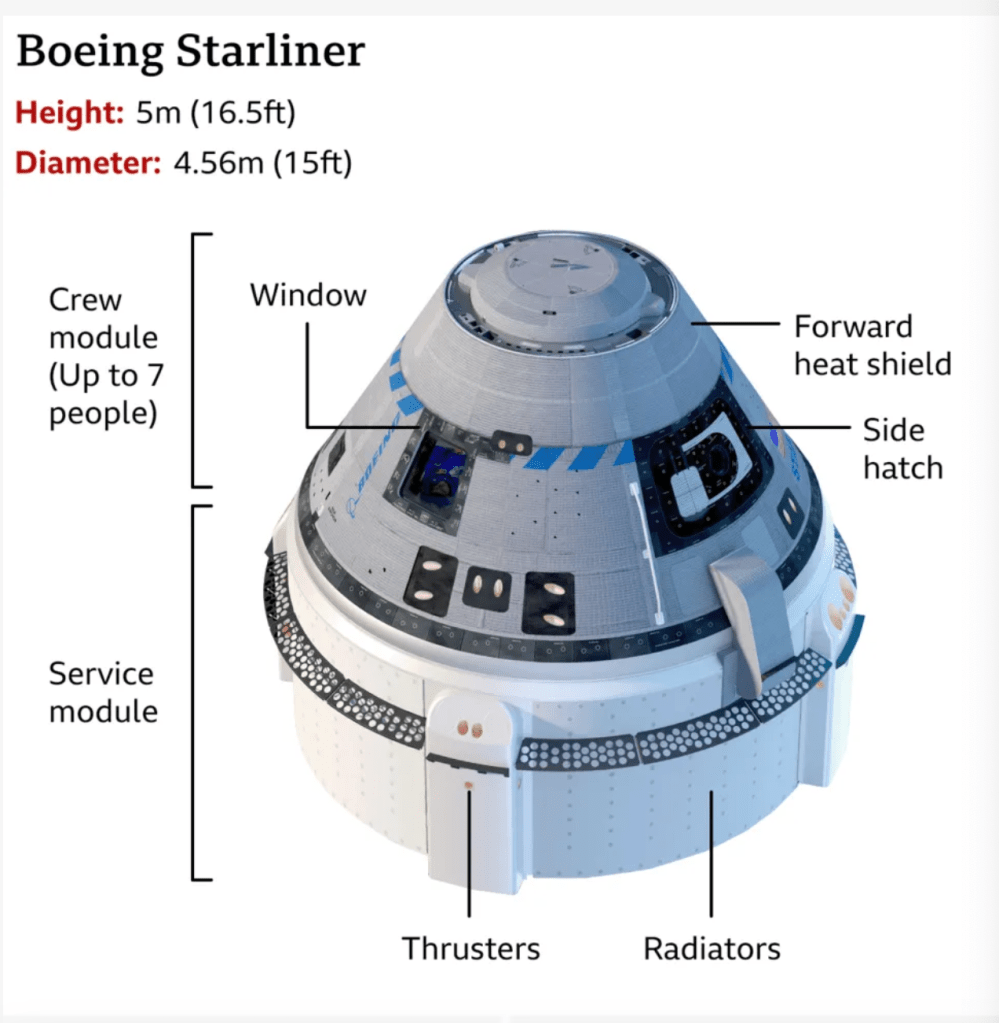
Boeing Starliner is 5m ( 16.5ft0 high and 4.56m (15ft) diameter, weighting 760lbs (340kg) of cargo, with crew module which can accommodate unto 7 people. A key supply item is a replacement pump for the system on the ISS that purifies urine back to drinking water. Much of the cargo, is simply Boeing merchandise that will become memorabilia for this vital test flight, which includes mission patches, coins, silver Snoopy pens, American flags and a hard drive with about 3, 500 pieces of artwork from children across the world. If everything goes to plan, Wilmore and Williams will return to Earth late next week. The Starliner is designed to come back to land, using airbags to soften contact with the ground, and touchdown could be performed in several place in the US southwest, depending on local weather forecasts before making a final choice.
 The neptune Herald
Leave a comment