
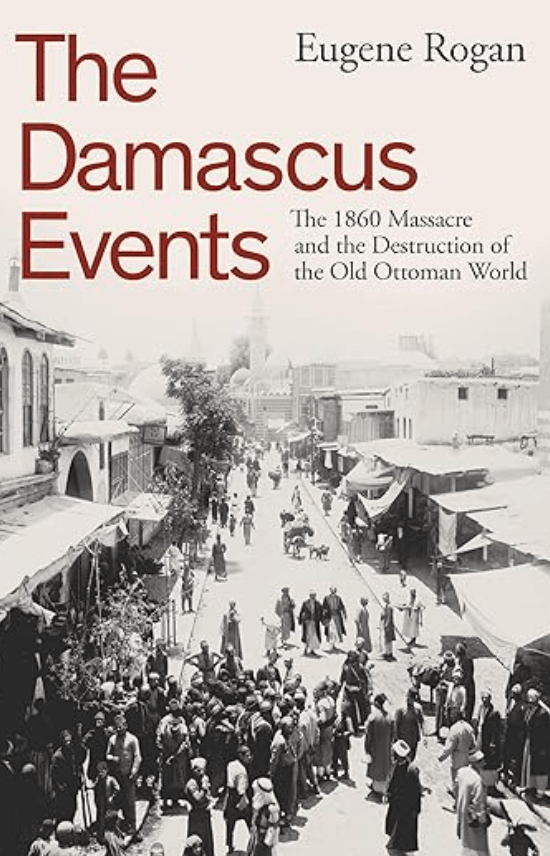
This is an essential book for understanding the emergence of the modern Middle East from the destruction of the old Ottoman world.
How the rule of law was restored to the birthplace ce of Judaism and Christianity, Damascus, after a massacre in 1860s, and the veneration in Island, the eastern littoral of the Mediterranean Sea, the most historically burdened place in the world.
For centuries this city has drawn in powerful states aspiring to hegemony over the Holy Land, as the minorities sought refuge from persecution and pilgrims on their way to Jerusalem and Mecca. Russian warships refuel at their Syrian base, the US pumps Israel with arms notwithstanding President Biden’s recent decision to pause the supply of bombs the might be used on civilians in Rafah – and Iran and its proxies chip in with drone and rocket attacks.
Eugene Rogan, a professor of Oxford University and author of a widely admired history of the Arabs, reveals in his accessible, enlightening account of an episode from a low point in late July 1860, when Damascus’s surviving Christians cowered in the citadel and the mob outside bayed for their blood, events took an inspiring turn for the better. Rogan recreates the lost world of the Middle East under Ottoman rule, the mighty empire was under pressure from global economic change and European imperial expansion. Reforms in the mid-nineteenth century raised tensions across the empire, nowhere more so than in Damascus. A multifarious city linked by caravan trade to Baghdad, the Mediterranean and Mecca, the chaos of languages, customs and beliefs that made Damascus a warily tolerant place. Until the reforms began to advantage the minority Christian community at the expense of the Muslim majority. But in 1860 people who had generally lived side by side for generations became bitter enemies as news of civil war in Mount Lebanon arrived in the city. Under the threat of a French expeditionary force, the Ottomans dealt with the disaster effectively and ruthlessly.
The Ottoman Empire based in Istanbul, also known as Constantinople, and disintegrating under pressure from assertive minorities and their European sponsors. Damascus, the region’s political centre and major departure point for Hajj pilgrimage, was focus of political and social tensions. Members of the city’s 12,000-strong Christian community had taken to flaunting the legal equality that the sultan had recently granted them with their Muslim neighbours, as well as exploiting the protection they received from foreign consuls. In the early 1860s, massacres were committed by the Druze community of heterodox Muslims on Christian Maronites in their shared homeland of Mount Lebanon, 60 miles west of Damascus. On July 9 Damascus itself erupted in violence and by that evening the sky was li by fires raging in hundreds of Christian houses, the familiar sounds of a Damascene summer, the croaking of frogs and the barking of stray dogs drowned out by cries of the fire, of breaking open houses.
Mikhayil Mishaqa, an influential Arab Christian and US consul in the city. On July 9, Mishaqa barely escaped with his life, when the mob broke into his house. Blinded in one eye, one arm slashed and bleeding, he threw fistfuls of coins to distract his attackers, who went on to target churches and monasteries and put monks and priests to the sword. After a week of killing, some 5, 000 Christians lay dead. Looking forward to the collapse of the Ottoman Empire more than half a century later, in the course of which 1.5mn Armenian subjects of the Sultan were killed on death marches and in massacres. The Ottoman Empire in the 1850s was both more humane and more supple than it would become.
The saviour of Damascus who arrived in the city on July 29 was an Ottoman functionary named Mehmed Fuad Pasha, deputed by Sultan Abdulmecid 1 to put an end to the violence and thus deny the European powers any pretext to intervene this experienced and reform-minded diplomat did not hesitate to execute those of his fellow-Muslims who bore responsibility for the massacres, including the disgraced former Ottoman governor.
Did Fuad pursue the looters, guilty Damascenes wishing to dispose unobtrusively of their ill-gotten gains opened their windows under the cover of darkness when “clothing, bedding and personal property rained down into the alleys and streams of the city. Temporarily housing destitute Christians in a cleared Muslim quarter. Fuad was rewarded for his handling of the crisis with the grand vizierate- from which position he assigned funds and political backing for the permanent reconstruction of the city.
Fraud’s measures were so effective, even a French force which landed on the Lebanese coast to protect Christians was forced to leave for lack of anything to do, while Mishaqa became a convert to Ottoman ecumenism. Christians and Muslims united in nationalist movements and forged a secular identity to which all Syrians might subscribe. This only collapsed with the outbreak of civil war in 2014, when fault line was not between Christians and Muslims but between Sunni Muslims and their Alewife co-religionists.The Damascus Events is a blue print on how the worst can be avoided through justice and reconciliation overseen by a credible political authority.
The Damascus Events: The 1860 Massacre and the Destruction of the Old Ottoman World, Allen Lee £35, / Basic Books $33m 400 pages.

 The neptune Herald
Leave a comment