
On September 5 1951 Elzbieta Zawacka arrived home from her teaching job to find two officials waiting for her, Ransacking her tiny flat in Torun, northern Poland , they pounced upon a cotton-reel containing a $10 note, money she had given to her late mother who had never spent it. Owing foreign currency in communist Poland carried a 10-year prison sentence with torture.
She had already fought to defend Lvov , then a city in eastern Poland now in Ukraine and known as Lviv, from the Nazis and joined the Home Army – one of the largest resistance movement in Europe. She had run a network of couriers taking vital information. To the Polish government in exile in London had helped to train volunteers secretly in Britain’s Special Operations Executive of underground resistance fighters and been the only woman to be parachuted back into Nazi-occupied Poland.
This was all accompanied by considerable physical challenges, including being half-drowned I the water-tender of a German train and being bombed by the English in Stuttgart, struggling through deep snow in the Pyrenees and being shot at by border guards. Zo had managed to cross more than 100 waterline frontiers.
Historian Clare Mulley meticulously annotated with footnotes and copious endnotes, reveals for the very first time previously unsung told of women in the defence of their homeland, and a detailed account of the turbulent history of Poland in the 20th century “Agent Zo had set herself two missions in life: to bring freedom to her country and equality of opportunity, rank and recognition to her fellow servicewomen, She had trumped in both”. Invaded simultaneously by Hitler and Stalin, Poles still managed to provided nearly half of Britain’s wartime intelligence, as well as making an invaluable contribution to the Battle of Britain and to campaigns in Italy in Libya. Polish citizens sought refuge in England after 1945, they were not made welcome. In the late 1960s, by which time Zo was a professor at Gdansk University, where she began to create an invaluable archive, securing testimonials from her old contacts, particularly the women whose enormous contribution had been so undervalued.
Zo had adopted innumerable identities, becoming the humble peasant, the weeping widow, the stern academic, the wealthy businesswoman, the enclose nun. She had struggled, argued, run and even fainted as occasion demanded, she had fought with bare hands and raw courage throughout the terrible days of the Warsaw Uprising when Hitler demanded the deaths of every citizen, man, woman and child, and 80 per cent of the city was destroyed, A mere prison sentence would not break her. As many attested, nothing could.
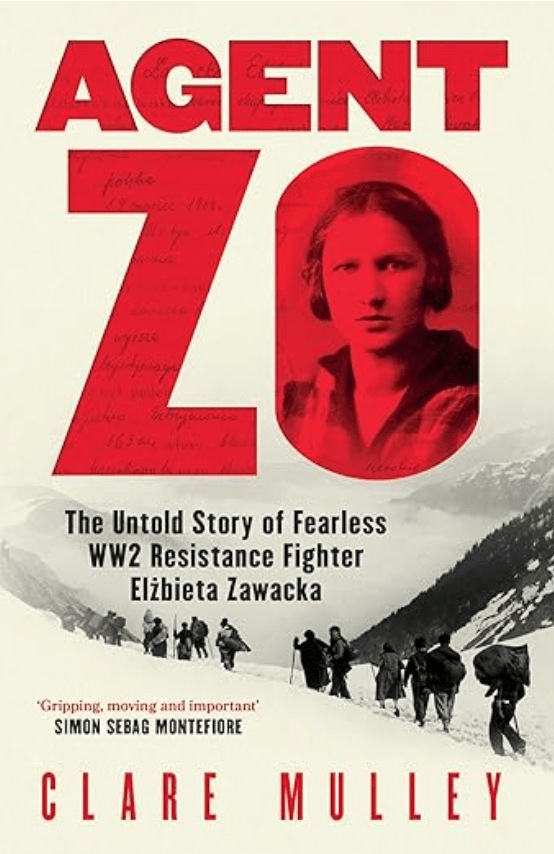
Agent Zo Elzbieta Zawacka, the WW2 female resistance fighter was the only women to Rach London from Warsaw during the Second World War as an emissary of the Polish Home Army command, and then in Britain she became the only woman to join the Polish elite Special Forces, known as the “Silent Unseen”. There, whilst being hunted by the Gestapo who arrested her entire family, she took a leading role in the Warsaw uprising and the liberation of Poland.
After the war she was demobbed as one of the most highly decorated women in Polish history. Yet the Soviet-backed post-war Communist regime not only imprisoned her, but also ensured that her remarkable story remained hidden for over forty years. Now through new archival research and exclusive interviews with people who knew and fought alongside Zo, Clare Mulley brings this forgotten heroine back to life and also transforms how we see the history of women’s agency in the Second World War.
Agent Zo: The Untold Story of Fearless WW2 Resistance Fighter Elzbieta Zawacka by Clare Mulley, weidenfeld & Nicolson £22, 416 pages

 The neptune Herald
Leave a comment