
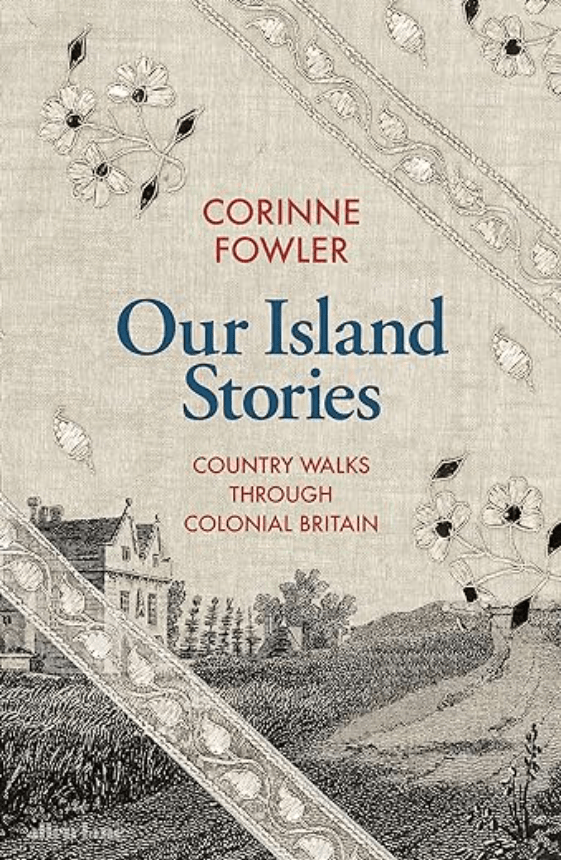
Do you cherish British countryside, the moors and lochs, valleys and mountains, cottages and country houses. Historian and professor of colonialism and heritage at the University of Leicester, Corrine Fowler brings rural life and colonial rule together with transformative results, through ten country walks, roaming the island with varied companions. She connects the Cotswolds to Calcutta. Dolgellau to Virginia and Grasmere to Canton.
Empire transformed rural lives for better and for worse, whether in Welsh sheep farms or Cornish copper mines, it offer both opportunity and exploitation. Flower shows how the booming profits of overseas colonial activities, and the select few who benefited, directly contributed to enclosure, land clearances and dispossession. These histories, usually considered separately, continue to shape live across Britain today.
The Historian Raj Pal, “stabbing the air with a chip,” noters that the East India Company, which ruled much of the subcontinent for a century, promoted not only bigoted thugs, but connoisseurs of Indian culture.
The eleven walks she sets out on though houses, parks, coasts and hills confirm that “ exploring the history of Britain’s countryside is not incompatible with a love for it”. Her itinerary, take her from Wordsworth country in the Lake District to idyllic Dorset villages, from Scottish Islands to the foothills of Snowdonia, from northern mill towns to Cornish creeks amend the flamboyant Mughal-style fantasy palace of Sexincote in Gloucestershire, Everywhere she tells multi-layered stories of trade, Empire, wealth, conflict and protest that continue the “intimately local and sweepingly global”.
The rich colonial slavery brought to many landed estates loom largeL for the Jamaica-trading branch of the Campbell clan, who purchased the islands of Islay and Jura, as much as for the Draxes of Dorset, with their Barbadian sugar holdings.
How the Atlantic traffic in humans, and the plantation system it fed, “intertwine” with profound change at home – whether the enclosure of common land in East Anglia or the pivot from American to Indian cotton in Lancashire mills. In a society that lived or died by overseas commerce, a “vast intercontinental geography” might transform the sleepiest hamlet.
The role of Welsh wool in clothing enslaved workers before abolition, the Welsh-Guyanese academic Charlotte Williams insists that historical discussion “is nothing to do with finger-wagging”.
She refuses to deploy John Wordsworth’s ill-fated ambitions in the opium business as a cheap “gotcha” to sabotage his brother William’s poetry.
Lancashire’s cotton king’s dependence on plantation slavery hardly belongs in the same explanatory frame as John Constable sailing on an East India Company ship.
Fowler’s argument that colonial history abroad and labour history at home count as “two sides of the same coin”. Many slavers, bankers and traders ploughed their assets into picturesque scenery then became peasant-evicting Highland landlords, commons-encloses in Norfolk, or persecutors of pioneer trade unionist in Dorset.
Some readers may not desire to new British history “through a prism of guilt and fear” may simply be struck by how much of the world – and the past- finds its way into sheep-cropped valley slopes, Georgian harbour towns or flower-bedecked cottages surrounding village greens, Past pains shadow present pleasures, but never quite extinguish them.
Island stories mingles chatty and lyrical travelogue with digests of scholarly research.
Our Island Stories: Country Walks Through Colonial Britain by Corinne Fowler, Allen Lane £25, 432 pages.

 The neptune Herald
Leave a comment