
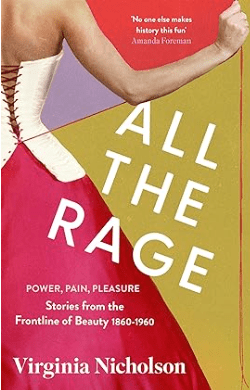
Are you in front of the dressing table history, a place where your dreams come true, doubts, self-harm and hopes. Who determines which shape is currently “all the rage”? How to custom, colour, class and sex fit into the picture/ Virginia Nicholson explains how advances made by feminism collided with the changing shape of desirability. The pain is Gladys’s botched surgery on her nose, Dorothy, whose skin colour lost her an Oscar, Beccy who took slimming pills and died, and the radioactive corsets.
The New Women who discovered freedom by bobbing their hair, the boyish, athletic “ Health and Beauty” ladies in black knickers and starlets in bohemian beachwear. Among the first to experience true women’s liberation were the early adopters of trousers.
All the Rage tells the story of western female beauty from 1860 to 1960 chronicling its codes, its contradictions, its lies, its highs and its underlying power struggle.
In 1920, a 49-year-old Parisian travelled to America for the beauty procedure, said” I’m just crazy with joy about it all. But dare not smile. That would start the wrinkles all over again. I would never have needed an operation if I hadn’t gone around laughing and crying over nothing all my life.”
Ladies were willing to sacrifice life’s emotions for the sake of appearance was an obvious trade off for many of women into all consuming pursuit of beauty.
All the Rage is a book about women’s relationship with appearance and the external forces that shaped it, from corsets and cosmetics to diets, exercise and plastic surgery.
The 1860s was a period in which women were constrained both socially and sartorially with boned corsets and voluminous crinoline skirts, also this was time of rapid industrial and technical innovation that saw the establishment of the haute Couture industry in Paris, the increased availability of affordable ready-made clothing, and the growth of photography- the birth of modern fashion industry.
Nicholson literally undressed the professional beauties included Princes Alexandra and Brigitte Bardot, layer of clothing removed, disclosing intimate and revealing facts about women’s lives and experiences across all segments of society. The ideal female body morphs and changes as corsets, busts, flapper dresses, shoulder pads and the bikini each make their demands.
Women experienced greater freedom, as more body was revealed, external scrutiny grew – along with the pressures to live up to changing expectations.
Women attained increased rights including the power to vote and access to further education and jobs outside of the home.
Cosmetics could be risky, Victorian face powders contained paralysis inducing lead, while liquid rouge contained corrosive ammonia or potash. The proprietor of a Bond Street salon the 1860s and a lucrative trade in blackmailing her clients under the threat of revealing which treatments they’d had.
As the dawn of the 20th century, the cosmetics industry pushed ever more idealised standards, profiting from women’s insecurities while also providing unparalleled opportunities for women entrepreneurs such as Helena Rubinstein and her rival Elizabeth Arden who founded global cosmetics brands. Daughters of formerly enslaved people, Annie Turbo Malone and Madame CJ Walker, who built their respective fortunes by catering to the African American haircare market from the 1900s. Nicholson notes “the real beauty campaign the “body positivity movement” and “fat-pride” co-exist with body dysmorphia, voyeurism and extreme misogyny.”
All the Rage: Power Pain, Pleasure: Stories from the Frontline of Beauty 1860-1960 by Virginia Nicholson, Virago £25, 528 pages.

 The neptune Herald
Leave a comment