
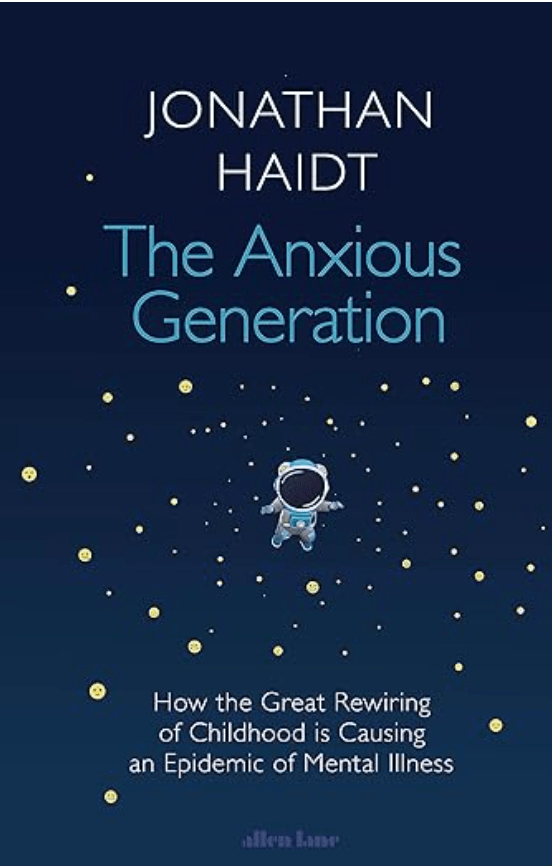
Social psychologist, professor of ethical leadership at New York University’s Stern School of Business, Jonathan Haidt, reveals why have rates of depression, anxiety, self-harm and suicide risen so sharply, more than doubling in many cases in recent years. Haidt’s International bestselling author of the Righteous Mind (2012, looking at the role of emotion and reason in moral convictions) and The Coddling of the American Mind, (2018, co-written with Greg Lukianoff describing a culture of “Safetyism” in which helicopter parents and educators protect their young charges from potential har, including even thoughts), Haidt argues that the decline of free-play in childhood and the rise of smartphone usage among adolescents are the twin sources of increased mental distress among teenagers. After intense psychological and biological research to show how, between 2010 and 2015, childhood and adolescence got rewired. As teens traded in their flip phones for smartphones packed with social media apps, time online soared while time engaging face-to-face with friends and family plummeted, and so did mental health. This profound shift took place against a backdrop of diminishing childhood freedom, as parents over-supervised every aspect of their children’s lives offline, depriving them of the experiences they most need to become strong and self-governing adults. The Anxious generation reveals the fundamental ways in which this shift from sleep deprivation to addiction- with separate in-depth analyses of the impact on girls and boys. This ancient wisdom, eye-opening book is a life raft and a powerful call-to-arms, offering practical advice for parents, schools, governments, and teens themselves.
The advent of social media, gaming and smartphone has disastrously “rewired childhood”. Policymakers and parents in many countries worry about the impact of smartphones. The British grassroots movement Smartphone Free Childhood has been spreading, set up by parents who aim to keep the devices out of their kid’s grip. In the UK, the issue has gained a higher profile because of the case of the transgender teenager Brianna Grey, murdered by two fellow school pupils last year, her mother Esther Grey, has campaigned vociferously for controlling social media for under-16s. Florida governor Ron DeSantis signed a new law enacting similar restrictions, other US states are considering such interventions. While scrolling through X or Googling Haidt writers that “Gen Z” – people born between 1997 and 2012 is the “first generation in history to go through puberty with a portal in their pockets that called them away from the people nearby and into an alternative universe that was more exciting, addictive , unstable and unsuitable”.
Despite the fact that most tech companies set a minimum age for users of 13, social media is particularly pernicious for young adolescents , whose brains are still developing, Haidt argues, drawing on reams of data, its likes and comparisons can have powerfully destructive effects.
Several US teenage boys reporting at least one major depressive episode a yer jumped by 161 per cent between 2010 and 2020m and the increase among girls was only marginally less, as several adolescents are brought in for emergency psychiatric care in the US between 2010 and 2020.
The rate of self-harm among young adolescent girls nearly tripled while that for girls 15-19 doubled:”So whatever happened in the early 2010s, it hit pre-teen and young teen girls harder than any other group”.
In 2021, the Facebook whistleblower Frances Haugen claimed that the company’s “own research says it is not just that Instagram is dangerous for teenagers, that it harms teenagers, (but) that it is distinctly worse than other forms of social media”. ( Mark Zuckerberg called this a “mischaracterisation of Meta’s research.)
Haidt points the finger at parents for not allowing their children freedom to take physical risks, arguing that they “should supervise less in the real world but more in the virtual”. He also suggests that schools should encourage free play rather than being so focused on testing.
The Anxious Generation by Jonathan Haidt, Allen Lane £25. Penguin Press $30, 400 pages.

 The neptune Herald
Leave a comment