
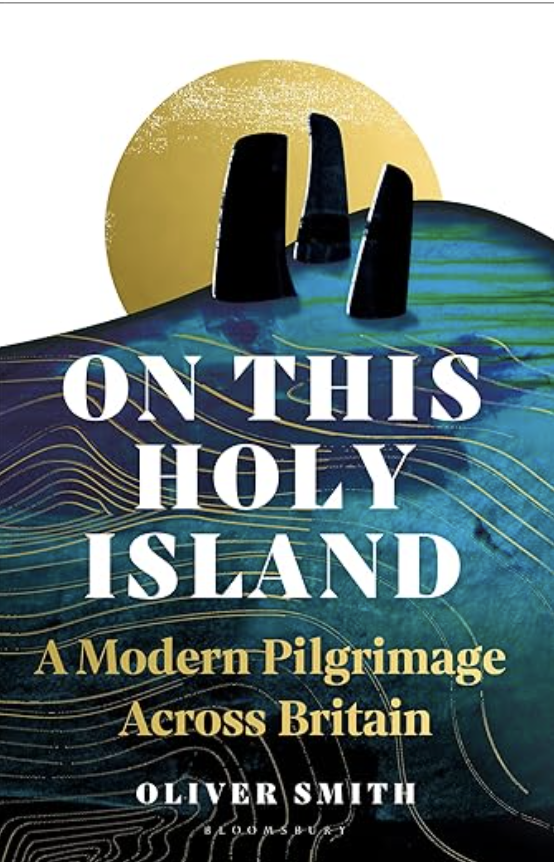
Travel writer Oliver Smith takes us to sacred travel made across time, from murmurs
of ritual journeys in the depth of Ice Age to new pilgrimages of the 21st century finding sanctity in remote peninsulas and holy islands. He embarks on an epic adventure across sacred British landscapes – climbing into remote sea caves, sleeping inside Neolithic tombs, scaling forgotten holy mountains and once marooning himself at sea, following holy roads to churches, cathedrals and standing stones, this evocative and enlightening travelogue explores places prehistoric, pagan and Christian, but also reveals how football stadiums and music festivals have become contemporary places of pilgrimage. The routes walked are often ancient, the pilgrims he meets are always modern, But underpinning the book is a timeless truth that making journeys has always been a way of a path goes in tandem with “the unravelling of the soul”.
Every summer solstice, thousands of people gather at Stonehenge to greet the longest day of the year, dating back to pagan Britain. In 1974 hippy commune who decided to host a free festival among the stones. The Pope, the Dalai Lama and John Lenon were invited. Smith searches for more out-of-the way spots, climbing into Paviland Cave on the Gower Peninsula the oldest ceremonial burial ground in Europe, hiking to the Old Forge on the Knoydart Peninsula,
Smith blends ancient with the modern in his pilgrimages to hallowed sites in Britain, as he walks across the mud flats towards Lindisfarne, the holy tidal island off Northumberland’s coast: “ Pilgrimage is seen as having the symmetry of life: our Jerusalem, our paradise”. He also grumbles about the price of parking. He worked for Lonely Planet magazine for a decade, was “in the road”. Losing his job as the pandemic slammed shut borders he could not tramp the Camino de Santiago in Spain. Smith’s itinerary is an array of hallowed places and roaming Britain from sea caves to railway lines to fly-tipped suburbs, including Iona Abbey and Glastonbury. He also leads us to lesser-known pilgrimage destinations like Walsingham, a tiny village known as “England’s Nazareth” where the Virgin Mary appeared in 1061.
Smith tries to camp out in St Herbert’s Island, in the Lake District, a magical launch pad to haven, for the saint it is named after, but rodents, send him packing at dawn.
On the Chalky Ridgeway in Southern England, a sacred path that he explores for its prehistoric elements albeit under the Heathrow flight path – he meets the ranger who is custodian for the Bronze Age Uffington White Horse, “the perfect companion for a pilgrim’s road” which appears across dry Ridgeway valley.
He also vividly describes how the horse is re-chalked annually, “Cared for as though it were a living thing”. He throws some light into Wayland, the home of Saxon god of metal working, which has attracted a far right group gathering as defenders of the “purity” if Anglo-Saxon. Smith claims the pilgrimage routes are hard to make sense of , afflicted as they are by “the prejudices, priorities and peculiarities of others”. Every pilgrimage is unique and what is required is an open mind. To embark with hope and then “ to break through the crust of the familiar to find the fantastical”.
On This Holy Island: A Modern Pilgrimage Across Britain by Oliver Smith, Continuum £20, 256 pages.

 The neptune Herald
Leave a comment