
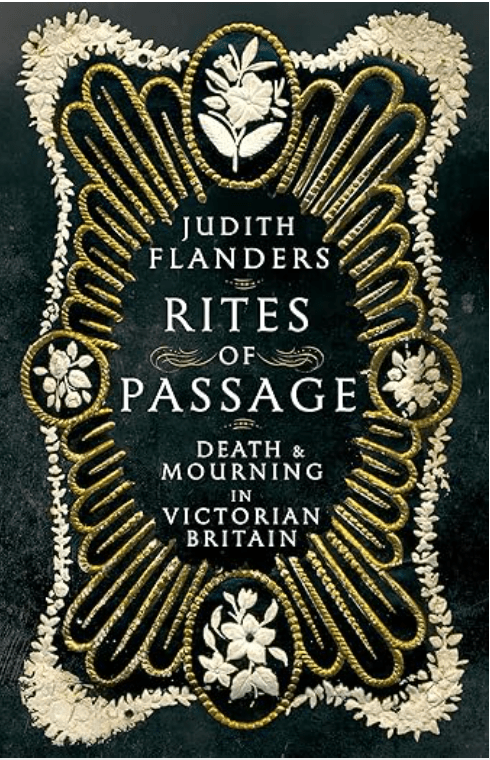
Acclaimed Historian Judith Flanders an expert on everyday life in Victorian Britain deconstructs the intricate fascinating reveals the bizarre customs that grew up around death and mourning in Victorian Britain. Stories from sickbed to the deathbed, from the correct way to grieve and to give comfort to those grieving to funeral and burials and the reaction of those left behind, Flanders illuminates how living in nineteenth-century Britain was, in so many ways, dictated by dying.
Deeply researched chilling social history of a period plagued by infant death, poverty, disease and unprecedented change. In elegant, often witty prose. Flanders brings the Victorian way of death vividly to life.
In Charles Dickens’ seventh novel, Dombey and Son, which reveals the heart-rendering death of young Paul where Dickens was conscious that many of his own faithful disciples had lost entire families to tuberculosis, typhoid and cholera, the killers of 1800.
Judith in Rites of Passage demonstrates the socioeconomics of death in the long 19th century with details of attending a major funeral costing more than £1000 in today’s currency, for a restricted view of the crimson-covered coffin containing George IV’s 21-year-old daughter Princes Charlotte and her stillborn son, the brutal Poor Laws Act of 1834 created a “hierarchy of despair” as per Flanders, Francis Kilvert, a young clergy man in Wales, met a labourer sobbing by the roadside because a black jacket – all he owned- was deemed made adequate attire for his mother’s funeral.
Prince Albert’s death in 1861, Flanders described the view of England’s over stocked textile merchants with Queen Victoria’s demands for public mourning at on point she planned to plunge her entire army into black a horrible mixture of dyed wool and treated silk, and court ladies compelled to wear it for year on end. In 1897 the queen still forbade her maids of honour from wearing mauve ( too close to cheerful pink). Queen Victoria’s doctor, William Jenner described Victoria’s grief as “a form of madness.
Flanders shows how cemeteries gradually took the place of the old-fashioned churchyards where, even when coffins were unceremoniously piled on top of each other, space soon ran out. In 1809, Mary Shelley’s father, William Godwin, lamented that tombstones were being shuffled off like stubble, ready for next year’s crop. From the middle of the century, new garden cemeteries began sprouting everywhere. The commercially minded Victorians turned death and mourning into profit. A craze for wearing black jewellery brought wealth to the little seaside town of Whitby.
Big public funerals, like the Duke of Wellington’s in 1852 attracted crowds of around 1.5 million people were good for innkeepers along the route. Cashing in on the funeral in 1865 if a beloved boxing champion Tom Sayers, vendors flogged ballads outside the gates of Highgate cemetery, while a local cookshop, offered a assuage grief with pricey plate of superior brisket.
Rites of Passage: Death and Mourning in Victorian Britain by Judith Flanders, Picador £25, 352 pages
 The neptune Herald
Leave a comment