
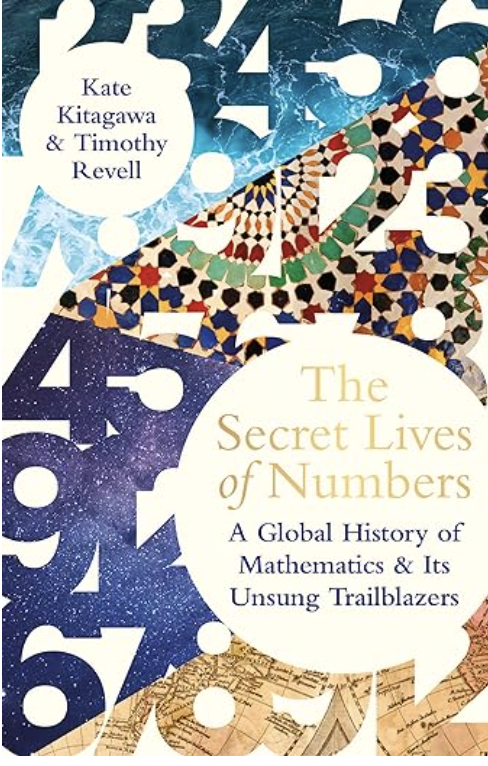
Mathematics shapes almost everything we do. But despite its reputation as the study of fundamental truths, the stores we have been told about it are wrong,
Brilliant Arabic scholars of the ninth-century House of Wisdom, and the pioneering African American Mathematicians of the twentieth century to the “lady computer’ around the world who revolutionised our knowledge of the night sky, we meet these fascinating trailblazers and see how they contributed to our global knowledge today. Kate Kitagawa, director of the Space Education Office at the Japan, Aerospace Exploration Afghanistan and Timothy Revell’s ( deputy US editor at the New Scientist, new history The secret lives of Numbers eluded ancient mathematicians until around the 7th century in India- when the figure went from being a mere place holder to a number that could actually be computed. The Mathematical boundary-smashers who have been erased by history because of their race, gender or nationality.
The Secret Lives of Numbers is an attempt at course corrections: we hear of the Persian mathematician Jamshid al-Kashi, who determined pi to 16 decimal places in the 15th century, two more than we need now to launch rockets into space: of how Pythagoras theorem might instead he called the Gougu Theorem name after the two sides of a triangle in Chinese, the first language the theorem was recorded in. We also encounter the true origins of calculus, born not for Isaac Newton or Gottfried Leibniz but in 14th century Kerala, where Mahadeva of Sangamagrama hit upon a form of infinite series that relied on calculus to deduce one of the giants on whose shoulders Newton claimed to have stood.
In mathematical history women never received the recognition accorded to their make counterparts: Pandrosion, the 4th century solvelrl of the cube-doubling problem, but long assumed to be a man despite the female pronouns accorded to her by a contemporary. Hypatia, head of the Mouseion in Alexandria, a pagan and a mathematical prodigy who built astrolabes and hydrometers, wrote exercises to accompany Diophantus’s Arithmetica, and probably lived a life of celibacy, rebuffing the approaches of her students by claiming them with music. In the 17th century Elisabeth of Bohemia, the only person I have so far found who has completely understood all my previously published word according to Rene Descartes.
The Secret Life of Numbers: A Global History of Mathematics & Its Unsung Trailblazers by Kate Kitagawa and Timothy Revell, Viking £20, 320 pages.
 The neptune Herald
Leave a comment