
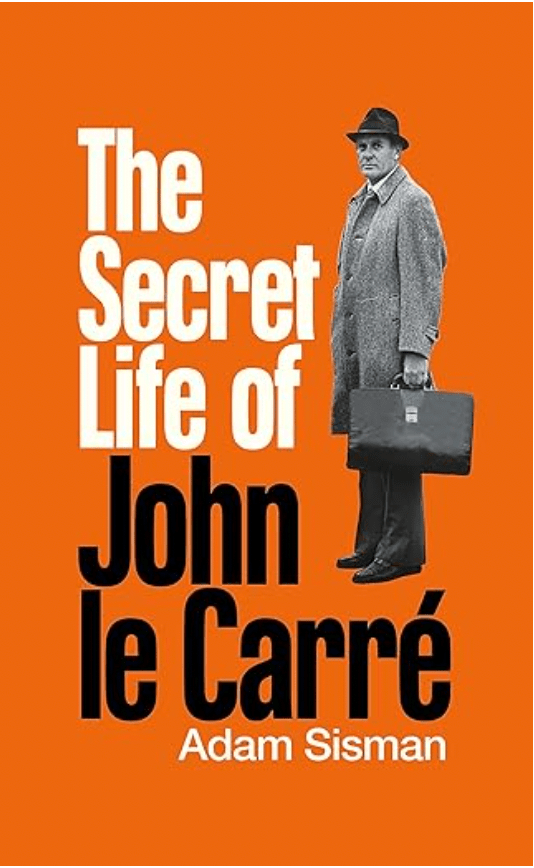
Secrecy came naturally for John le Carré, and there were some secrets that he fought fiercely to keep. The content of his marriage, the novelist conducted a string of love affairs over four decades. To keep these relationships secret, he made use of tradecraft that he had learned as a spy: code names and cover stories, cut outs, safe houses and dead letter boxes. Such affairs introduced both jeopardy and excitement into what was otherwise a quite, ordered life. Ot was the stimulus these affairs provided in order to write though this meant deceiving those closest to him, so betrayal became a recurrent theme in his work. The Spy Who Came in from the Cold, anchored John le Carré’s literary reputation. Adam Sisman’s second attempt following his acclaimed biography of le Carré in 2015, the new biography of its author, whose double life is revealed as extending well beyond being a pseudonym for the writer David Cornwell. Sisman identifies 11 women with whom le Carré had affairs between 1972 and 2002, and he known there were plenty mor4e besides. Usually younger than he, they ranged from his son’s au pair to the estranged wife of his neighbour the novelist Nicholas Mosley. Yvette Pierpaoli, who an aid worker, lost her life in a car accident in 1999, while Janet Lee Stevens , who had interpreted for le Carré in the Middle East, was killed in 1983 in the blast that destroyed the US Marines barracks in Beirut. The affairs influenced le Carré’s work. His relationship with Sue “Suleika Dawson sparked the writing of his most autobiographical novel. A Perfect Spy (1986), Stevens was a partial inspiration for the heroine of The Little Drummer Girl (1983) and Pierpaoli for that of The Constant Gardner (2001). It was an earlier lover, Liese Deniz who suggested that Alec Guinnness could be suitable for the part of George Smiley in the Television adaptation of Tinker, Tailor, Soldier, Spy. Like Ian Fleming he was a womaniser, the women’s task being to bolster his insecurities about his literary ability. “My infidelities” le Carré told Sisman , “became almost a necessary drug for my writing”. It was always he who ended the affair. Every new book, it seems required a new muse and the roots of his promiscuity probably lay in his fractured relationship with his mother, Olive, who left the family home without saying goodbye to her young children. He was also shaped by the example of his conman father, Ronnie, to the extent that he said he too would have become a criminal had he not been a writer. Like his shadow self Magnus Pym, the protagonist of The Perfect Spy, he believed himself to have no real moral centre.
Spying is process of beterayal and according to Sisman the management of his affairs replaced the thrills that John le Carré missed after forsaking his career in espionage when his writing took off with The Spy Who Came in from the Cold. John le Carré equated spying with adultery, both are processes of seduction, often a fantasy about what will happen when the couple involved finally get away from what is oppressing them. John le Carré remained withhis wife in “the Spy who came in from the Cold”, Alec Leamas ultimately chooses not to climb over the Berlin Wall.
A doubt is cast on the extent of his work for MI6, the mystique of which he cultivated. “a sad, sympathetic portrait of a man who has lived by lies and subterfuge for so long he’s forgotten how to tell the truth” referring to Alec Leamas, the novel’s burnt-out spy.
The Secret Life of John le Carré by Adam Sisman, Profile, £10.00, 175 pages.
 The neptune Herald
Leave a comment