
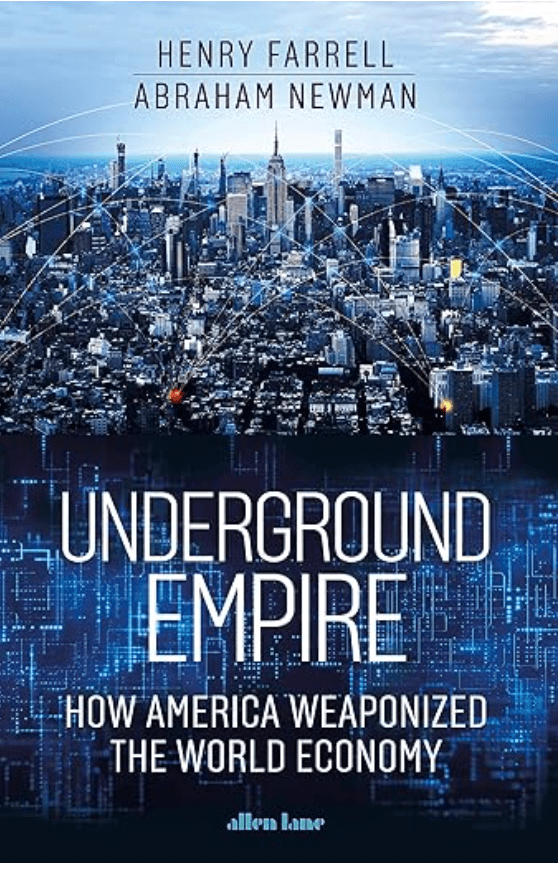
This is the story of how the United States has turned the most vital pathways of the world economy into tools of domination over foreign businesses and countries, rivals or allies allowing to maintain global supremacy. This underground empire has allowed the United States to eavesdrop on other countries and isolate its enemies. Efforts by China and Russia to untether themselves from this coercive US-led system are turning the global economy into a battle zone. Trade wars, sanctions, and controls on technology exports are merely tremors hinting at far greater seismic sifts beneath the surface , as we sleepwalk into dangerous new struggle for empire.
America’s power from military hardware to the software of social media, and the hidden network of fibre and wires that the US employs to weaponise its financial system against both enemies and allies.
Foreign policy specialist Henry Farrell and Abraham Newman reveals America’s efforts to control the world economy by seeking out and manipulating a subterranean communications network of tunnels and conduits and by taking charge of key intersection of the network, the US government could secretly listen to what adversaries were saying to each other or freeze them out of the global financial system.
The authors interview financier Walter Wriston who helped to create the offshore Eurodollar market away from US bank regulations and the borderless and stateless hopes he had for finance. He climbed the top of Citicorp, where he was CEO from 1967-1984 and the less memorable MARTI (Machine Readable Telegraphic Input.
The other banks chose to sidestep Citicorp’s efforts to monopolise a digital messaging system for transactions, as European institutions formed their own correspondence system with the snappler name of Swift (Society for Worldwide Interbank Financial Telecommunications). Tracking profit raised through criminal activities led to money laundering charges against Asian and European banks. MARTI disappeared as Swift’s encrypted format won over the world’s banks, including all important ones about 11, 000 banks use it in 200 countries. Although North Korea does not use it, Russia’s largest banks Gazprombank, remains on it.
Swift enabled speedy movement of capital around the world and early adaptation of the internet primarily occurred within US borders.
The US had the bulk of the world’s internet data traffic coursing through these arteries. When Edward Snowden leaked secret National Security Agency documents in 2013, he revealed Strombrew, an NSA map with eight key US internet exchanges around the country including San Francisco. The success of US security agencies in tracking data encouraged law enforcement officials to use similar methods, particularly against foreign banks, Tracking the path of profits raised through criminal activities led to money laundering charges against Asian and European banks. Once a foreign bank committed any offence under US laws within the American Financial System, they became fair game.
Hongkong and Shanghai Banking Corporation (HSBC) caught in the sticky web of the US Department of Justice in a 2012 money laundering case. They eventually settled with the DoJ later led the bank to divulge information about a Chinese client, telecommunications supplier Huawei and led to the arrest of Huawei’s CFO Meng Wanzhou and daughter of its founder Ren Zhengfei in Canada. This has provoked a natural response to avoid dealing in the US dollar, not just by China and Russia, but by America’s allies as well.
The idea that US power still lies hidden within underground networks of financial and other data is not a convincing thesis.
Underground Empire: How America Weaponized the World Economy by Henry Farrell and Abraham Newman, Allen Lane £25, 288 pages.
 The neptune Herald
Leave a comment