
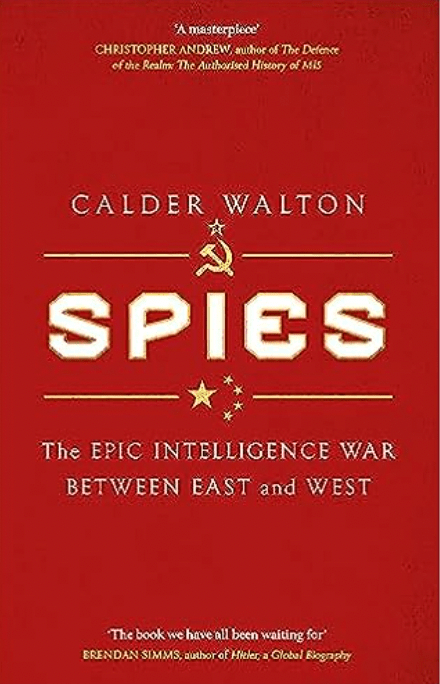
Spies is an inspiring story of the best and worst of mankind: bravery and honour, treachery and betrayal. From the freezing streets of St. Petersburg in 1917 to the bloody beaches of Normandy, from coups in faraway lands to present-day Moscow, where troll farms weaponise social media against Western democracies.
The West has a long-term Russia problem, not a Putin problem. Spies mines hitherto secret archives and exclusive interviews with former agents to tell the history of the war that Russia and the West have been waging for a century. The secret report about Ukraine reached British intelligence in February, which said that the Russians knew the Ukrainians were hostile to them and their ideas and that the Ukrainians wanted to know what foreign support they could receive . The spy who wrote the report continued “ I pointed out to him the Ukrainian source that no power would intervene against Russia now, and that the Russians would never permit the Ukraine to separate itself entirely form Russia.” This was written in1922, a century before Moscow launched its full-scale invasions of Ukraine.
Walton, a British barrister, author and historian currently at Harvard, who previously spent several years in MI5’s archives as a researcher for the official history of the UK’s domestic secret service.
How often the West failed to realise it was in a spy war at all, – a failing as true of a century ago as today.
The cold water started long before 1947, when the phrase was coined by Bernard Baruch, financier and adviser to several US presidents. In the 1920s, there was Lenin’s secret police, the Cheka, had more than 100, 000 agents at home and a dedicated unit to co-ordinate operations abroad. MI5’s counter-espionage unit had five officers. In 1929, secretary of state Henry Stimson had closed the government’s code-breaking department because “gentlemen do not reach each other’s mail”.
The cold war did not end in 1991 with the Soviet Union’s collapse, but Russian spying became more aggressive. In 2003, Vladimir Putin, a former KGB agent and spy chief became president as estimated 2.5 per cent of Kremlin staff had a security background. By 2019, that figure frog marched to 77 per cent.
In Waltons words “ the hooligans of international relations using all the tools of KGB trade craft espionage, deep-cover illegals, money-laundering, assassinations, disinformation and other active measures while the west, who believed the cold war with Russia was over, were looking elsewhere.
After the terrorist attacks of September 2001, western countries diverted bulk of their security resources into counter-terrorism. By 2006. Only 4 per cent of the work done by GCHQ Britain’s cyber intelligence spy agency, was concerned with hostile foreign nations, although at the height of the cold war over 70 per cent of its work had focused on the Soviet Bloc.
The west slow to recognise China’s threat , as its economic weight makes it more challenging and potentially dangerous than the Soviet Union. Beijing like Moscow has engaged in massive technological transfer from the west or spying and buying as Walton calls it,
Walton explains how China and its spies have become like the Soviet Union of steroids western intelligence is now chasing a horse that has already bolted the stables. He says it will be hard for the US and its allies to catchup.
There was nothing unprecedented about Russian meddling in the 2016 US presidential election. The cold war started long before 1945, as Western powers gradually fought back after the second world war, mounting their own shadow war, deploying propaganda, recruiting intelligence networks and pioneering new spy technologies against the Soviet Union.
Spies: The Epic Intelligence War Between East and West by Calder Walton
Abacus £25, 640 pages.
 The neptune Herald
Leave a comment