
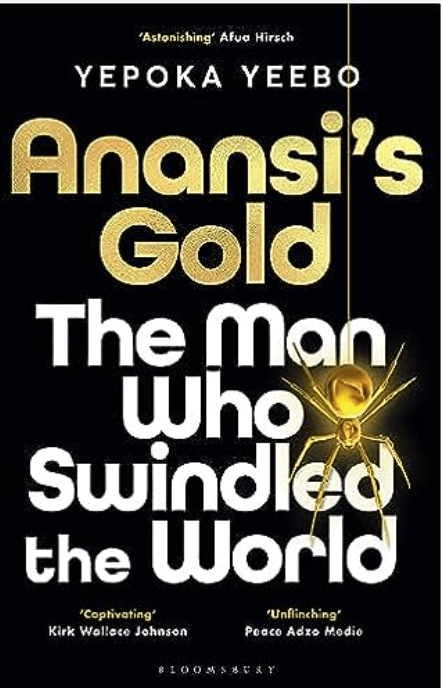
Anansi’s Gold is a riveting account of Cold War entanglements and African dreams revealing the untold story of the grifter who beat the West at its own thieving game.
A high-rolling Ghanaian fraudster committed acts that most people find repulsive. Yepoka Yeebo, a British-Ghanaian journalist, with her debut Anansi’s Gold, tells a remarkable story of John Ackah Blay-Miezah, a charismatic Ghanian huckster who for two decades masterminded “one of the greatest con artists of all time”.
Blay-Miezah had multiple aliases, who claimed to be , diplomat, doctor, banker, Harvard professor and a UN consultant. He was also fond of high-end hotels. His real name was John Kolorah Blay, and he’d grown up poor in the coastal village of Alengenzure.
He was in prison in the US in 1972 for failing to pay the bill at a Philadelphia hotel while impersonating an emissary of the Ghanaian government – that Blay-Miezah concocted his biggest trick, the one that would make him notorious and his The Oman Ghana Trust Fund.
The fund set up by Kwame Nkrumah Ghana’s first post-independence president, who had reportedly creamed off large amounts of his country’s wealth – some $27bn un casg abd diamonds and 30, 000 gold bars, all hidden in Swiss banks. To access the funds, Blay-Miezah simply needed money in advance. Anyone who invest was promised a 10-fold return. The whole thing was fiction, despite allegations of corruptions, Nikrumah was in fact a hero of the independence movement who steered his country to have a more balanced relationship with world powers. From 1973-1986 Blay- Miezah and his American partner Robert Ellis, made away with millions of dollars defrauding hundreds of people in the process. Blay- Miezah continued the scam for more years after Ellis left the enterprise. Even John Mitchell – Nixon’s attorney-general got himself involved, having been promised astronomical returns.
Mitchell’s connection to the scheme helped Blay-Miezah burnish his reputation as a well-connected international businessman.
Greed and personal ambition, hubris, instilled the gamble as many were convinced the money existed somehow. He sold people stories that suited their political objectives.
Even an African-American priest James Edward Woodruff, who ministered at the prision in Philadelphia, and became a passionate believer in economic freedom for African states. Blay-Miezah even baffled Henry Kissinger, scandalised Shirley Temple-Black. Many tried to stop him, but Blay-Meizah continued to live in luxury, protected by ex-SAS soldiers while he deceived lawyers, businessmen and investigators around the globe.
Woodruff ended up introducing Blay-Miezah to Ellis who arranged the hotel bill to be paid, and Blay-Miezah to be freed with disastrous results.
To black people, Blay-Miezah and Ellis were selling liberation a chance to repair the wounds of colonialism. To everyone else they were selling the chance to loot an African country’s ancestral wealth.
Before and after Ghana’s independence in 1957, in the decade before independence Yeebo claimed Britain extracted £ 150 million from the country. Nkrumah succeeded in bringing home gold reserves being held in London.
After Ghanaian independence a succession of military rulers like Jerry Rawlings, president from 1981-2001, who allegedly enriched himself and his cronies at the country’s expense while espousing faux-revolutionary ideology.
John Ackah Blay-Miezah dropped dead of natural causes in 1992, while under house arrest – one last escape. But Ellis went to jail.
Anansi’s Gold: The Man Who Swindled the World by Yepoka Yeebo, Bloomsbury £20/ $29.99, 499 pages.
 The neptune Herald
Leave a comment