
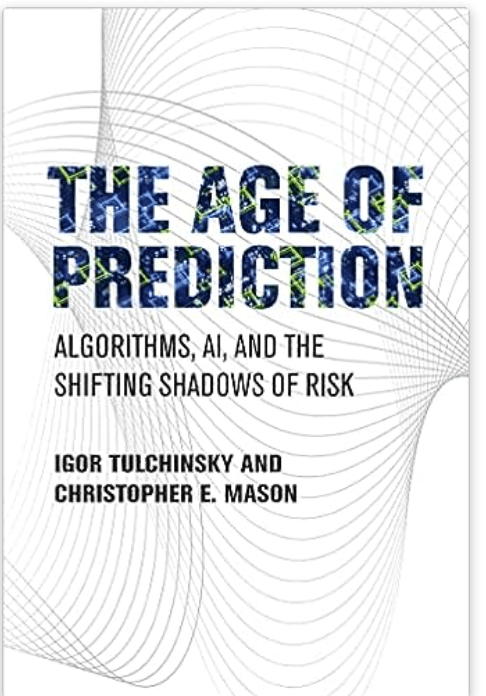
The power of Algorithms for prediction and their paradoxical effects on risk. The Age of Prediction is about two powerful, and symbiotic, trends and the rapid development and use of artificial intelligence and big data to enhance prediction, as well as the often paradoxical effects of these better predictions on our understanding of risk and the ways we live. Dramatic advances in quantitative investing and precision medicine, and how predictive technology is quietly reshaping our world in fundamental ways, from crime fighting and warfare to monitoring individual health and elections.
Investor Igor Tulchinsky and Cornell professor of Genomics Christopher E Mason, reveals the results of a new survey of how predictive algorithms are changing the world.
Back in 2016, Google DeepMind’s AlphaGo program defeated the reigning world champion at Go. Four years later, the company’s AlphaFold program solved one of the biggest puzzles in modern biology, the challenge of predicting the molecular structures into which proteins fold, based only on the sequences of their constituent amino acids.
Then late last year came the public release of Open AI’s ChatGPT – the first of a large language Models that exhibit unique abilities to sustain humanlike conversations and have left the famous Turing Test for dust.
The tsunami of data that the digitization of human life has generated and the development of new statistical techniques able to discover pattens in this Big Data more effectively than ever before,
A large section of the Big Data in question is genetic, as now it is possible to sequence the 3bn base-paies of a human genome for less than $200 in under eight hours using a small machine, genomics “ can now be deployed at every crime scene, in every bedroom, toilet or turnstile”.
The fantasy portrayed by the cult 1997 film Gattaca, in which individuals genomes are used to predict their futures and regulate their roles in society, is fast becoming a real possibility.
Attempts to predict human behaviour have historically been plagued by moral hazard, Human’s ability to discern what predictions are being made and deliberately scheme to frustrate them.
If everything becomes predictable, there will be no uncertainty, and no such thing as free will.
The Age of Prediction: Algorithms, AI, and the Shifting Shadows of Risk by Igor Tulchinsky and. Christopher Mason, MIT Press £26, $27.95, 252 pages.
 The neptune Herald
Leave a comment