
Across four centuries from Ireland to India, the Americas to Africa, and Australia, British colonialism was above all the business of corporations, conceived promoted, financed, and governed overseas expansion, making claims over territory and peoples while ensuring that British and colonial society were invested, quite literally, in their ventures. Colonial companies were also relentlessly controversial, frequently in debt, and prone to failure. The corporation was well-suited to overseas expansion not because it was an inevitable juggernaut but because, like the empire itself, it was an elusive contradiction: public and private; person and society: subordinate and autonomous, centralized and diffuse; immortal and precarious, national and cosmopolitan – a legal fiction with every real power.
Corporations often take a supporting role by doing the dirty work of sovereign states in exchange for commercial monopolies. Whether in sixteenth-century Ireland and North America or the Falklands in the early 1980s, corporations were key players, Empire, Incorporated makes clear, venture colonialism did not cease with the end of empire. Its legacies continue to raise questions about corporate power that are just as relevant today as they were 400 years ago.
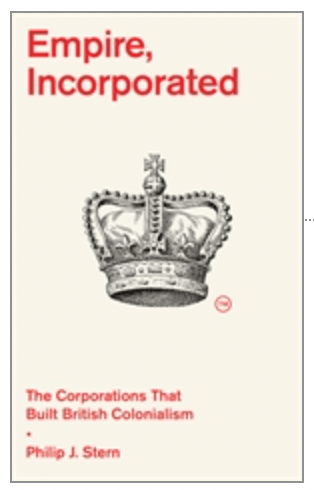
Associate professor at Duke University, Philip Stern’s new book Empire: Incorporated, focuses on the pivotal role played by corporations and joint-stock companies. These bodies did the vital business of enabling overseas British colonialism, while sucking in widening numbers of Britons at home.
White Man’s crimes were taught that empire- with all its vices and virtues- was built by monarchs and statesmen.
The East India Company, a private British company with its own powerful army that dominated India, were pioneers, explorers, inventors and dreamers, who said the company is dedicated for connoisseurs of the world’s best teas, coffees and more, their “Fine Food & Lifestyle” store is waiting for collectors of precious gold and silver coins, at 97 New Bond Street.
Stern reveals Britain’s earliest private enterprises were failures. A 1578 expedition to seek out the Northwest Passage returned with just 1, 000 tons of worthless rocks. Overseas ventures regularly lost their lives though rarely in such numbers as the indigenous peoples they encountered and increasingly enslaved along their way. Richard Chancellor’s ship was aiming for Cathay when it landed instead at Arkhangelsk in 1553, which became the serendipitous origin of England’s Muscovy Company and its regular trade with Russia. The two other ships that set out with Chancellor, lost their way and their crewmen seem to have frozen or starved to death.
People were desperate for new life and location. In the 1820s hundreds of Gregor MacGregor’s fellow Scots ploughed their savings into his semi-scam of a territory, Poyais, on the coast of Nicaragua or opted to settle there. Most lost money and their lives. The more respectable lures of the Canada Company, the Australian Company and the New Zealand Company.
Early overseas traders became the UK benefited from having access to advanced print networks. A joint stock enterprise divided up its stock into portions that could be purchased not just by company’s partners but also by outsiders. The East India Company, founded in 1600 proclaimed , it was “collected and contracted out of all sorts and ranks of men”. A minority of women soon began acquiring stocks either through their own initiative or through the wills of attentive husbands, fathers and brothers.
Some social Conservatives were revolted by the medley of folk drawn into these enterprises. These hybrid organisations could alienate in other ways too. Ambitious corporations often sought and obtained royal charters. They also regularly demanded the protection of British Crown’s armed forces. Once richly established overseas – and as demonstrated in Massachusetts and other American colonies after 1775, such chartered enterprises might get above themselves and attempt autonomy. Corporations warned Thomas Hobbes grimly, were “worms in the entrails” of the body politic, and not simply destabilizing but also corrupting.
Accusations of corruption were most consistent directed against the biggest joint stock company of them all, the East India Company. Given exclusive jurisdiction over English in all trade in Asia in 1600, by 1760 it was the defacto ruler of Bengal and grasped much more. For Edmund Burke, the late 18th-century political philosopher, the company was guilty both of oppressing and draining India, and of subverting the proper authority of the British Monarch and Parliament. Defender retaliated that the company understood India far better than a distant Westminster. They also summoned up realpolitik, “The love of money” declared one imperialist in the late 1800s, had always lain “at the root of empire”.
Overseas Imperial corporations were in fact in retreat, though not entirely or invariably so. When Bismarck’s newly unified Germany began establishing its own African and Pacific colonies in the late 19th century, it made abundant use of these organisations. Huawei as a modern variant of Empire incorporated – as an ostensibly private corporation that exercises public functions and advances public schemes overseas and not just in Africa.?
Empire, Incorporated: The Corporations that Build British Colonialism by Philip J Stern, Belknap Press, £ 30.95/ $35, 408 pages.
 The neptune Herald
Leave a comment