

Bad jobs and low wages, minimal benefits, no career paths, little or no training, and chaotic schedules are only way companies can keep costs down and prices low as 9 million retail works get $10.37, and 7 million restaurant workers $9.50 per hour. If companies offer better jobs, customers would have to pay more or companies would have to make less. At least one in four American working adults has a job that pays less than a living wage. In the past three years large companies including McDonald’s, Walmart, GAP and Aetna have raised wages. Why are companies investing in and empowering their workers after treating them so poorly for so long? Companies in saturated markets need more growth from their existing units. Those facing increased competition from brick-and-mortar and online rivals need to give customers a compelling reason to buy from them, When operations are designed to allow frontline works to be productive, empowered and customer-focused companies and workers can expect a lot from one another. At good jobs companies, store managers feel like owners. Taking care of customers and developing employees and their most important tasks. Companies have just began to realise that engaged workers are more productive, provide better service, and are less likely to jump ship. In restaurants and retail, the turnover of staff in 2016 averaged over 73 per cent and 65 per cent respectively.
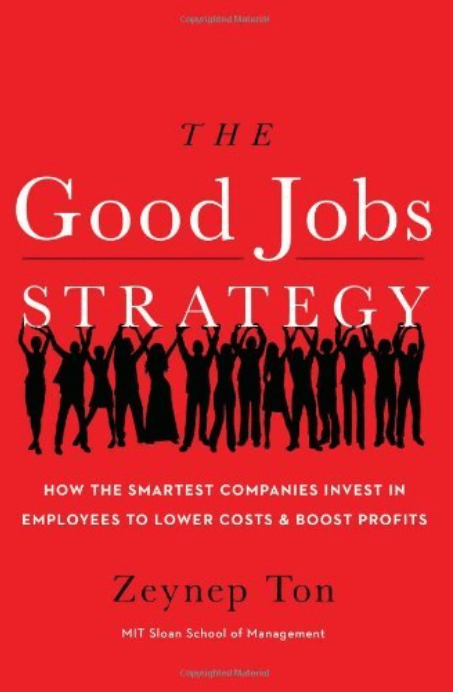
In The Good Job Strategy, Zeynep Ton, an MIT Sloan School of Management professor, makes a compelling case that even in low-cost settings, leaving employees behind –with bad jobs- is a choice, not a necessity. After decades of research, Ton shows how operational excellence enables companies to offer the lowest prices to customers while ensuring good jobs for their employees and superior results for their investors.
Ton describes the elements of the good jobs strategy in a variety of successful companies around the world, including Southwest Airlines, UPS, Toyota, Zappos, and in-N-Out Burger. She focuses on four model retailers – Costco, Mercadona, ( Spanish supermarket chain with 1, 620 stores and 79, 000 employees) , Trader Joe’s and Quik Trip – to demonstrate the good jobs strategy at work and reveals four choices that have transformed these companies’ high investment in workers into lower costs, higher profits, and greater customer satisfaction.
Good Jobs Strategy, reveals counter intuitive insights, and explains How can offering fewer products increase customer satisfaction? Why would having more employees than you need reduce costs and boost profits? How can companies simultaneously standardize work and empower employees?
The Good Jobs Strategy is a invaluable bible for any organization that want to pursue a sustainable competitive strategy in which everyone – employees, customers and Investors all wins.
The Good Jobs Strategy by Zeynep Ton, Amazon Publising, £12.29, 240 pages.
 The neptune Herald
Leave a comment