
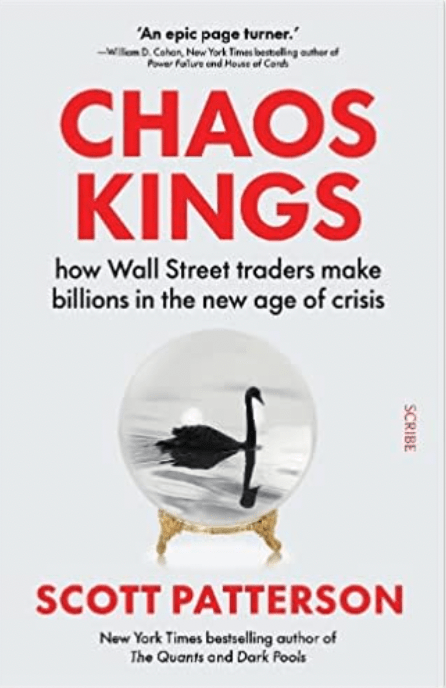
Scott Patterson, a veteran Wall Street Journal reporter, explains vividly the world of billion-dollar traders and high-stakes crisis predictors who strive to turn extreme events into financial windfalls. After the Pandemics, climate change, superpower rivalries, cyberattacks, political radicalization virtually everywhere we look there is mayhem bearing down on us, putting trillions of assets at risk. In Chaos Kings, Scott Patterson depicts how one faction led by Nassim Nicholas Taleb, bestselling author of The Black Swan, believes humans can never see the big disaster coming. Extreme events – so-called Black Swans while inevitable, will always catch us by surprise. In 2007, Taleb’s collaborator Mark Spitznagel, launched the Universa hedge fund , which would go on to make billions protecting investors against unforeseen chaos in the market. The other faction which relies on complex formulas. Believes looming chaos can be detected Chief among these risk prognosticators is Didier Sornette, a colourful French mathemathician who enjoys riding his motorcycle at speeds in excess of 170 miles per hour.
When Sornette looks out from what he calls his Financial Crisis Observatory in Zurich, Switzerland, what he sees are Dragon Kings – punishing events that are unlikely to occur but have probabilities that can be predicted and defined against.
In financial markets, doomongers are like warmongers, they have star quality, Investors who make decent money when stocks or bonds are waiting higher are often dismissed as riding a wave with little skill or foresight. Those who supercharge returns by picking up the best performing stocks or juicing up bets with borrowed money are frequently painted as lucky or even wreckless. Investors start bragging when they do well, when the markets are under stress. But rock star status is reserved for clique who have made storm-chasing in stocks and bonds in to something between an art and science and an extraordinary lucrative one.
Pattereson focuses on former trader Nassim Nicholas Taleb a divisive character who combines a fierce intellect, geninuely useful insights and a concern for the wellbeing of mankind with a frequently obnoxious public persona, especially online His Twitter spat with hedge fund manager Cliff Ashness.
Talib clicked with Mark Spitznangel, with whom he founded hedge and Empirica in 1999. The idea of the fund was to lose money, most of the time, by buying cheap unloved unwanted derivatives contracts and wait for years, for stocks to tank and the returns to roll in. If done right this gives clients insurance against disaster,just by allocating a small slice of their funds to the strategy.
At Fund Universa, Spitznagel is still managing tens of billions of dollars and churning out 4, 000 per cent returns around periods of dysfunction such as when Covid lockdown sent markets reeling in March 2020,
The experience of US pensions giant Calpers, which ditched its insurance from Universa and others just before Covid disaster struck is bracing. Is expensive tail-risk hedging actually worth the bother or does it amount to buying elaborate lottery tickets. Then there is squabbles over which tail-risk model is superior. Some believe to predict disasters that mere mortals consider to be random. When is a Black Swan a grey swan or a dragon king?
Chaos Kings: How Wall Street Traders Make Billions in the New Age of Crisis by Scott Patterson, Scribe £16.99

 The neptune Herald
Leave a comment