
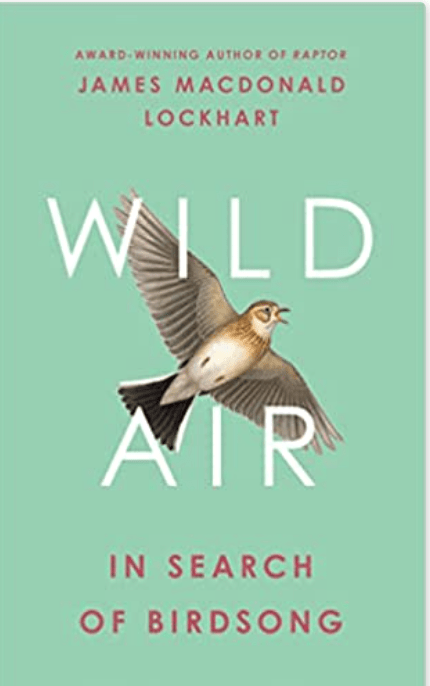
James Lockhart in Wild Air, write about a series of birds as though he has his granny’s role of listening to birds’ songs and calls and relaying what he heard to his aged and then quite deaf father- the famous naturalist Seton Gordon. From the nightjars’ strange churring song on a heath in the south of England, to a lapwing displaying over the machair in the Outer Hebrides, he writes about eight different birds who he has spent most time with, returned to most often and relays what he hears.
Watching birds is not merely entertaining m but also these animals are a crucial part of Earth’s ecosystems, engaging in essential activities such as pollinating flowers, spreading seeds and eating insects.
The study of birds has also influenced the course of science, helping to illuminate fundamental process of evolution from how natural selection works to ways that new species can form. With their capacity for flight birds are also truly global creatures making the mockery of human notions of borders and linking the farthest reaches of the Earth.
A migrating swift as world traveller will see more of the planet in a year than most of us will in their entire life as birds bind the planet together.
James Mcdonald Lockhart visits mountains, woods, heaths, lochs, streams, grasslands and field across Britain. He gives readers the experience of hearing the songs and calls of eight different species of bird dipper, divers, lapwings, nightingales. Nightjars, ravens, shearwaters, and skylarks. Lockhart treats the birds and their surroundings in inextricably linked. A dipper’s stream in clear cold running water, small pools, mossy banks. Manx shearwaters bring the ocean to the land “ Their guano is a rich marine fertilizer, transforming the mountain by supporting plants and insects that would otherwise be absent”. Birds like human fight, strut, dance, preen, bathe, flock together, groom each other, copulate and become harried by demanding insatiable young.
Different habitat of Nightjars on a lowland heath, shearwaters on a mountain overlooking the sea, dippers on a river, skylarks in farmland, ravens in woodland, divers on a loch, lapwings on the coast, and nightingales in dense scrub. Not all birds are songbirds in the traditional sense, though each possesses its own distinctive music and that music can vary from the strange as in the weird gurgling sound a shearwater makes insides its burrow, to the joyous exuberance of the skylark’s song.
Wild Air: In Search of Birdsong by James Macdonald Lockhart, Fourth Estate £18.99, 352 pages.
 The neptune Herald
Leave a comment