
Are you ready for the next wave of mobile innovation with unparalleled performance per watt, as Arm provides the performance, power and cost requirements of every device? On February 2023, Arm, the company founded in 1990, located in a former turkey farm barn in Swaftham, Bulbeck, a village outside Cambridge, developed a semiconductor design which was incorporated into 250bn computer chips. Another 1000 were being added to the number every second, powering everything in our digital economy from smartphones to cars to data centres. This tiny device lies at the heart of the world’s relentless technological advance and slivers of silicon are essential to running just about any machine, from household devices to cutting edge weaponary.
Unlike the big US chip companies, Arm was comparatively starved of capital, although that parsimony helped make the company’s processors uniquely efficient. The early backing of Apple, under Steve Jobs, perhaps propelled Arm into the big league. By collaborating with almost every major chip manufacturer, Arm licensed its technology globally and became a neutral “Switzerland of semi-conductors”. It created something that was “too convenient, too reliable and too cheap” for users to bother looking for an alternative.
Arm relied on a streetwise hustle, providing early inspiration to a succession of “deep tech” start ups to have emerged for Britain’s “Silicon Fen”. The company was an early beneficiary of the personal computer revolution founded by Austrian-born Cambridge physicist Hermann Hauser and Chris Curry, who started his entrepreneurial career as a school-boy sourcing television components from rubbish tips to make amplifiers for local rock bands.
Robin Saxby, was one of Arm’s early chiefs who was famous for his energy and creativity in winning over customers.
Ashton, former City Editor of Sunday Times, wrote “ Eccentric, relentless, but ultimately highly effective”, after following Arm’ story for many years and interviews its leading players in the corporate drama. Ashton also writes about the parallel development of the US and the Taiwanese chip industries, exploring the rise of Intel and Taiwan semiconductor manufacturing Company, and Nvidia.
Ashton recommends to British government to focus on training and skills and providing a stable tax and regulatory regime at a time when US, EU and China are pouring billions of dollars into subsidizing their chip industries.
The UK’s high-tech crown jewel is indispensable part of a global supply chain driven by American brains and Asian manufacturing brawn that has become the source or rising geopolitical tension.
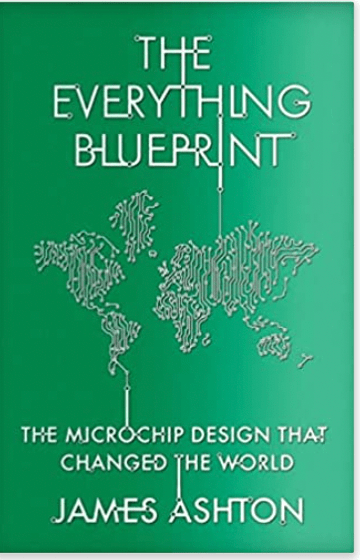
The Story of Arm, is detailed in The Everything Blueprint by James Ashton, from humble beginnings to the pivotal role in the moblle phone revolution and now supplying data centres, cars and the supercomputers that harness artificial intelligence.
It explores Arm’s enduring relationship with Apple and numerous other tech titans, plus its multi-billion pound sale to the one-time richest man in the world, Japan’s Masayoshi Son.
The titanic power struggle for control of the microchip through the eyes of a unique British enterprise that has found itself in the middle of that battle.
Arm has been far more highly valued by foreign strategic investors that fickle share holders in the City of London. In 2016, the SoftBank group owned by Masayoshi Son, said “ One day when I look back on my long life as an entrepreneur, I believe that Arm will stand out as the most important acquisition and investment I have ever made” after snapping up the company for £24bn a 43 per cent premium to its pre-offer share price.
Since the tech sector downturn Son is now looking to refloat Arm as a public cojpany to raise funds , despiste the best efforts of UK government to entice the company to relist in London, Arm will pop up again on New York’s Nasdaq market this year. American, Rene Hass is the current CEO is working out of its San Jose office. Ashton claims although Arm was quirkily British in its origin even if extraordinarily global in its impact.
The Everything Blue Print: The Microchip Design that Changed the World by James Ashton, Hodder & Stoughton £20, 464 pages.
 The neptune Herald
Leave a comment