

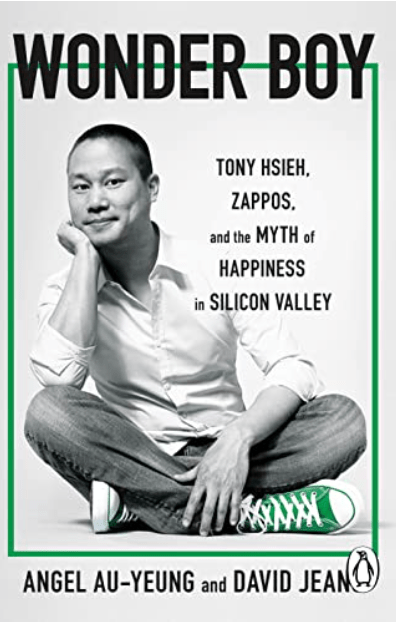
Wonder Boy investigates the rise and fall of tech wunderkind Zappos visionary, Tony Hsieh whose turbulent life aimed for happiness but ended his life in squalor and delusion. His radical business strategies revolutionized both the tech world and corporate culture, based on rigorous research, two journalists Angel Au Yeung ( Wall Street) and David Jeans, who investigated the aftermath of Hsieh’s death for Forbes, crafts a rich portrait of a man who was plagued by the pressure to succeed but who never lost his generous spirit. Tony Hsieh’s first successful venture was in middle school, selling personalized buttons. At Harvard, he made a profit compiling and selling study guides. In 1998, Hsieh sold his first company to Microsoft for $265 million. About a decade later, he sold online shoe empire Zappos to Amazon for $1.2 billion.
The secret of his success was making his employees happy. Zappo’s employee-friendly culture was so famous across the tech industry that it became one of the hardest companies to get hired at, and CEOs from other companies regularly toured the headquarters. But Hsieh’s vision for change didn’t stop with corporate culture. Hsieh went on to move Zappos headquarters to Las Vegas and personally funded a nine-figure campaign to revitalize the city’s historic downtown area. There, he could be found living in an Airstream and chatting up the locals. Hsieh’s forays into community-revival projects spun out of control as his issues with mental health and addiction ramped up, creating the opportunity for more enablers than friends to stand in his mercurial good graces.
From his earliest adventures in business, Hsieh ( Shay) set a goal of happiness, rather than riches. By the time he was 25, he had banked $32 million from the sale of an early venture.
His promise, hard work, risk-taking and success, concentrates his talent to building a footwear etailer Zappos, which he sold the business to Amazon in 2009 for $1.2bn, having delighted Jeff Bezos with his devotion to customer service and happiness at work. Hsieh kept his CEO position and said the takeover would leave its culture unchanged. He went on to make his mission the regeneration of downtown Las Vegas, where Zappos has its headquarters. His fame and success attracted yes-men, enablers, grifters and groupies and gurus and he died in 2020 aged 46, from injuries sustained in an avoidable domestic fire while under the influence of drugs.
The revolution in workplace joy at Zappos where Hsieh employed fungineers to create events for staff, the mental health of its architect was declining. Friends and family were unable to wean Hsieh from his dependence on alcohol, notably shots of the caustic Italian digestive Fernet-Branca, as well as ketamine and later nitrous oxide. Hsieh laboured under the delusion that he was part of the “1 per cent of people that can use these susbstances”.
The success of Delivering Happiness was not all it seemed. A manic promotional tour around the US eventually drove some of Hsieh’s staff to the brink of burnout, and Au-Yeung and Jeans write that Hsieh used a company that helps authors rise to the top of the bestseller lists.
Wonder Boy, Hsieh and a self-interested entourage hole up during the pandemic at a sprawling ranch in Utah, Park City., Greedy supplicants latch on tohis wild promises to fund even more outlandish plans, while the entrepreneur’s grip on reality is lossening under the influence of addiction to nitrous oxide, “his room looked like a homeless shelter”. Hsieh’s brother said in a later court deposition. “There was faeces on the ground. Plants in his toilets.. Rotten food under the bed. Rotten food on the walls .. It was all disgusting”.
Hsieh had what it takes to succeed as an entrepreneur, as he was a precociously brilliant student, who was able to inspire friends, colleagues and relative strangers simply by asking them, “ If you could do anything in this world, what would you do?”. He was not afraid to experiment with management methods, from flat hierarchy – using the controversial method known as Holacracy to the benefits of “flow” a focused state of concentration.
Hsieh pushed these ideas to dangerous extremes by using his fortune to bribe people to pursue his projects and to exclude those who saw danger ahead. During Zappos’s upswing, such perils were mitigated by the input of two close colleagues and friends who had formed a solid management “trifecta” with Hsieh “keeping Tony’s Chaos under control” and by 2014 both had left the company.
Hsieh once dreamed that Amazon would fall under the happiness spell he had cast at Zappos. Amazon has started taking closer control of Zappos, after Hsieh’s death, cutting jobs.
Wonder Boy: Tony Hsieh, Zappos and the Myth of Happiness in Silicon Valley by Angel Au-Yeung and David Jeans, Torva £16.99, 384 pages.
Success wasn’t all it seemed
Wonder Boy investigates the rise and fall of tech wunderkind Zappos visionary, Tony Hsieh whose turbulent life aimed for happiness but ended his life in squalor and delusion. His radical business strategies revolutionized both the tech world and corporate culture, based on rigorous research, two journalists Angel Au Yeung ( Wall Street) and David Jeans, who investigated the aftermath of Hsieh’s death for Forbes, crafts a rich portrait of a man who was plagued by the pressure to succeed but who never lost his generous spirit. Tony Hsieh’s first successful venture was in middle school, selling personalized buttons. At Harvard, he made a profit compiling and selling study guides. In 1998, Hsieh sold his first company to Microsoft for $265 million. About a decade later, he sold online shoe empire Zappos to Amazon for $1.2 billion.
The secret of his success was making his employees happy. Zappo’s employee-friendly culture was so famous across the tech industry that it became one of the hardest companies to get hired at, and CEOs from other companies regularly toured the headquarters. But Hsieh’s vision for change didn’t stop with corporate culture. Hsieh went on to move Zappos headquarters to Las Vegas and personally funded a nine-figure campaign to revitalize the city’s historic downtown area. There, he could be found living in an Airstream and chatting up the locals. Hsieh’s forays into community-revival projects spun out of control as his issues with mental health and addiction ramped up, creating the opportunity for more enablers than friends to stand in his mercurial good graces.
From his earliest adventures in business, Hsieh ( Shay) set a goal of happiness, rather than riches. By the time he was 25, he had banked $32 million from the sale of an early venture.
His promise, hard work, risk-taking and success, concentrates his talent to building a footwear etailer Zappos, which he sold the business to Amazon in 2009 for $1.2bn, having delighted Jeff Bezos with his devotion to customer service and happiness at work. Hsieh kept his CEO position and said the takeover would leave its culture unchanged. He went on to make his mission the regeneration of downtown Las Vegas, where Zappos has its headquarters. His fame and success attracted yes-men, enablers, grifters and groupies and gurus and he died in 2020 aged 46, from injuries sustained in an avoidable domestic fire while under the influence of drugs.
The revolution in workplace joy at Zappos where Hsieh employed fungineers to create events for staff, the mental health of its architect was declining. Friends and family were unable to wean Hsieh from his dependence on alcohol, notably shots of the caustic Italian digestive Fernet-Branca, as well as ketamine and later nitrous oxide. Hsieh laboured under the delusion that he was part of the “1 per cent of people that can use these susbstances”.
The success of Delivering Happiness was not all it seemed. A manic promotional tour around the US eventually drove some of Hsieh’s staff to the brink of burnout, and Au-Yeung and Jeans write that Hsieh used a company that helps authors rise to the top of the bestseller lists.
Wonder Boy, Hsieh and a self-interested entourage hole up during the pandemic at a sprawling ranch in Utah, Park City., Greedy supplicants latch on tohis wild promises to fund even more outlandish plans, while the entrepreneur’s grip on reality is lossening under the influence of addiction to nitrous oxide, “his room looked like a homeless shelter”. Hsieh’s brother said in a later court deposition. “There was faeces on the ground. Plants in his toilets.. Rotten food under the bed. Rotten food on the walls .. It was all disgusting”.
Hsieh had what it takes to succeed as an entrepreneur, as he was a precociously brilliant student, who was able to inspire friends, colleagues and relative strangers simply by asking them, “ If you could do anything in this world, what would you do?”. He was not afraid to experiment with management methods, from flat hierarchy – using the controversial method known as Holacracy to the benefits of “flow” a focused state of concentration.
Hsieh pushed these ideas to dangerous extremes by using his fortune to bribe people to pursue his projects and to exclude those who saw danger ahead. During Zappos’s upswing, such perils were mitigated by the input of two close colleagues and friends who had formed a solid management “trifecta” with Hsieh “keeping Tony’s Chaos under control” and by 2014 both had left the company.
Hsieh once dreamed that Amazon would fall under the happiness spell he had cast at Zappos. Amazon has started taking closer control of Zappos, after Hsieh’s death, cutting jobs.
Wonder Boy: Tony Hsieh, Zappos and the Myth of Happiness in Silicon Valley by Angel Au-Yeung and David Jeans, Torva £16.99, 384 pages.
 The neptune Herald
Leave a comment