
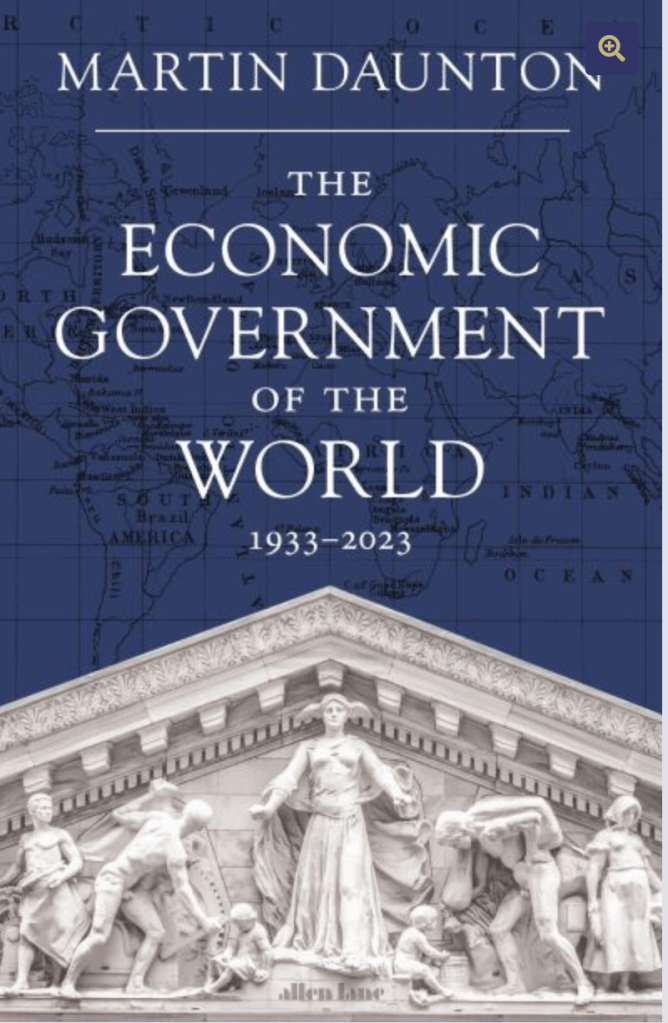
Martin Daunton scrutinises the swings of the pendulum over ninety years of democracy, national self-determination and globalization. He examines the epic history of money, trade and development and how the shifting political balance in the US is changing the agenda of global economic policy over the last ninety years between economic nationalism and globalization, explaining in detail why one economic order breaks down and how another one is built, in a. wide ranging history of institutions and individuals who have managed the global economy. Biden administration is unpicking globalization as we have known it in the Trump era.
This multilateral negotiations over currencies and trade, Daunton shows how the process of opening the door to the free movement of goods and capital was always messy and uncertain and dependent on domestic circumstances in America, the world’s leading economy.
This consensus in which nation-centered industrial policy plays an important role is sometimes construed as the betrayal of an earlier American vision of a rules-based multilateral order and this sense of rupture and reversal is misleading as it “shifts the distribution of economic power within the US’ which was crucial to Washington superintends “international economic order”.
The foreign trade appear to show a steady rise in global integration including merchandise exports as a share of global gross domestic product rose form a high of 14 per cent just before the first world war to 25 per cent by 2008 – building the institutional frame of globalization was a precarious business and much depended on fragile bargains between various interest groups to satisfy cotton farmers and textile producers, tactical decisions to separate contentious issues such as currencies and trade, and ensuring the maximum discretion for expert technocrats rather than congressional logrolling.
US was strongly a protectionist and efforts by Democratic party , which represents the farm exporters of the south tor reduce tariffs were stymied by the Republicans who spoke for northern industry. First 12 months of Franklin D Roosevelt’s presidency the direction of the policy was undecided, an indecision that contributed to the failure of the World Economic Conference in London in 1933, until FDR threw its weight behind the progressive project of the Second New Deal in the mid-1930s that the balance shifted decisively towards a more internationalist stance. Cordell Hull, Secretary of state bounced the Reciprocal Free Trade Act through Congress, which began to reverse the protectionist drift of the Great Depression. Henry Morgenthau brokered the Tripartite Currency Pact in 1936, which, after the collapse of the gold standard, stabilized Sterling and the Dollar against the French Franc.
To build a new economic order, Washington need partners, London still at the head of its empire, was desperate to be involved in shaping the world economy, and in John Maynard Keynes, the economist, it had the visionary for the job. After Second world war Britain was too weak to actually implement the Bretton Woods vision for full exchange convertibility as agreed in the summer of 1944, as it took billions in bilateral loans from the US , the Marshall plan of 1948 and the European payments Union of 1950s before Britain and the rest of Europe were ready for convertibility of their currencies in 1958.
The ambitious vision for the International Trade Organization, which would have promoted a fully multilateral trading system was abandoned in 1949, amid lack of constituency in America. Instead trade liberalization was driven forward in a more focused way by successive rounds of tariff cuts negotiated within the General Agreement on Tariffs and Trade.
By 1960s the recovery in east Asia and Europe was in full swing which posed its own challenges. Under the inspiration of Charles de Gaulle. the European Economic Community looked more like a closed economic bloc to ensure that Europe remained firmly within America’s orbit, the Kennedy Administration launched a new round of Gatt talks between 1964 and 1967, named in honour President Kennedy, was the closest thing to a true victory for all globalization in the post war era, as it brought the industrial tariffs down to new lows. The Pyrrhic victory, added to America’s trade deficit and caused resentment among American business and labour interests and it alienated the developing world.
By 197os the wreckage of the Bretton Woods System, the protectionist current was running strong in the US. President Richard Nixon took the dollar off gold and announced a new era of nationalism in economic policy, followed by Jimmy Carter and Ronald Regan who initiated the era of neo-liberalism at home through domestic deregulation and tax cuts, and flanked their domestic policies with slogans not of “free” but of “fair” trade. Market expansion was forged forward through regional deals such as the North American Free Trade Agreement. The Uruguay round of Gatt ( 1986-1994) dubbed “Gattastrophe” by its critics took seven and half years to deliver modest reductions in industrial and agricultural tariffs.
The World Trade Organization which replaced Gatt after 1995 was taken up by Europeans who were keen to constrain America’s unilateral tendencies. The WTO placed global development at the top of its agenda followed by wide ranging negotiations of the WTO’s Doha round involving 144 national delegations, organised into 19 separate coalitions, have been shambolic. China’s inclusion in the WTO delivered a fatal blow to political support for globalization in the US. By 2005, there was a bipartisan caucus in Congress calling for the US to leave the WTO paralysing the organization after Trump administration set about sabotaging the WTO’s dispute adjudication procedure. Biden administration however, has shown no real interest in reviving it. The prevalent diagnosis in Washington today is that the China-centric globalization of the 1990s and 2000s were a historic mistake.
America’s geoeconomics strategists, Jake Sullivan, President Joe Biden’s national security adviser, insist that they are not decoupling. America’s economic leadership will remain intact. In a mass of technical negotiations, anchored in political and interest group coalitions in the US, it will seek deals with partners in Europe, Asia and in the rest of the world.
The Economic Government of the World, 1933-2023 by Martin Daunton, Allen Lane £45, 1024 pages
 The neptune Herald
Leave a comment