
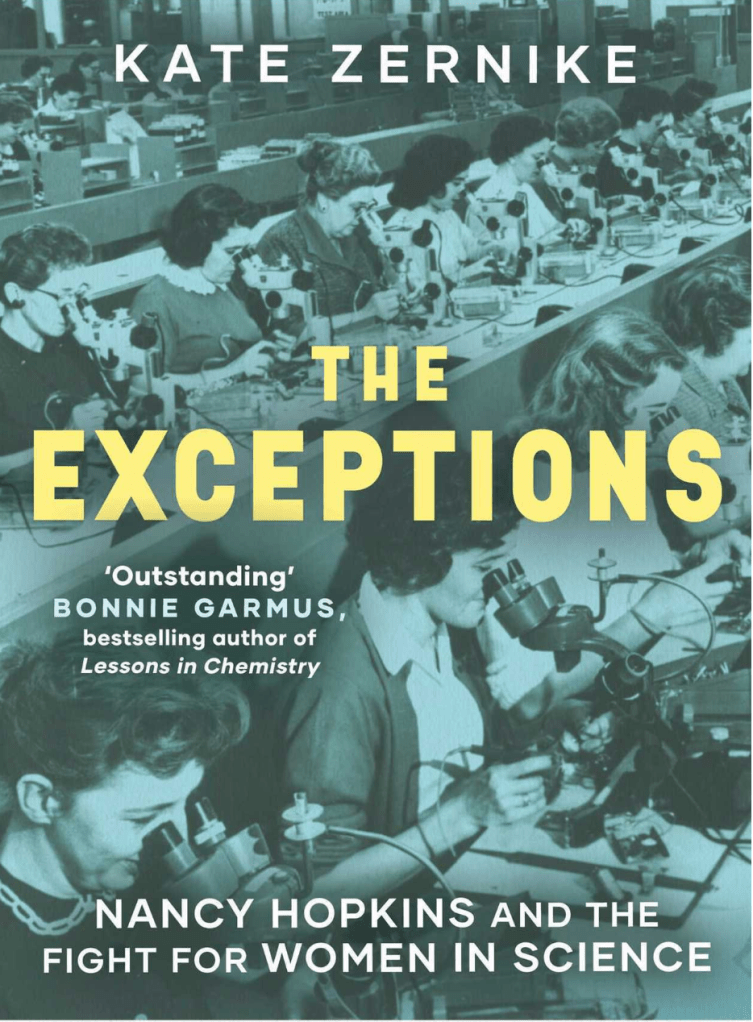
This is the story of sixteen determined women scientists who used the power of the collective and the tools of science to inspire ongoing radical change, and their fight for equality at MIT. These women entered the work force in the 1960s during the push for affirmative action. Embarking on their careers they thought that discrimination against women was a thing of the past and that science was pure meritocracy. These women were marginalized and minimized especially as they grew older, their contributions stolen and erased.
Kate Zernike, an Pulitzer Prize winning journalist for the New York Times correspondent, who broke the story in 1999 for The Boston Globe, When the Massachusetts Institute for Technology made the astonishing extraordinary admission that it discriminated against women professors on its faculty. Leading the charge was Nancy Hopkins, a molecular biologist who had joined the MIT’s Centre for Cancer Research in 1973, at a time when civil rights legislation led women to believe that discrimination was a thing of the past. Yet in 1994, there were still only 15 women with tenure at the School of Science, compared to 197 men. Hopkins was compelled to raise alarm bells when jostling for lab space put her research on Zebrafish genetics at risk. It was only when her female colleagues started to compare notes that they realised that the slight and appropriation they were experiencing were widespread and systemic. Evidence of a pattern convinced the university administration to investigate further, appointing a committee to compare the allocation of space, salaries, resources, leadership positions and teaching assignments. The resulting report identified the new shape of sex discrimination, the more subtle but still pervasive. Two decades later Zernike was inspired to write a book about it during the fallout of the #MetToo movement which struck her as an important but addressing only part of the problem. The Exceptions is an intimate narrative which centres on Nany Hopkins – a surprisingly reluctant feminist who became a hero to two generations of women in science.
In uncovering an erased history, we are finally introduced to the hidden scientists who paved the way for collective change.
Kate Zernike offers a non-fiction equivalent chronicling the fight for gender equality among the science faculty at the MIT. A 2018 report by the National Academic of Sciences, Engineering and Medicine found that 50 per cent of female faculty members had experienced sexual harassment, with the biggest complaint not sexual coercion but “put-downs about their intelligence, exclusion, and the kind of marginalization that the women of MIT had described twenty years earlier”. The gender pay gap persists in academia, and the US is in the midst of another debate for affirmative action.
The Exceptions: Nancy Hopkins and the Fight for Women in Science by Kate Zernike, Simon &V Schuster, £27, 416 pages.
 The neptune Herald
Leave a comment