
Emerging superpower India, now the world’s fifth largest economy, is set to overtake Germany and Japan as the third largest economy.
India last month overtook China as the world’s most populous country, with a population the UN estimates will reach 1.428bn by next couple of months.
India might profit from the demographic dividend of its still youthful population at a time of global business’s post-pandemic realignment of supply chains away from China. During its G20 presidency, Modi’s government has championed the notion that India’s moment as a leading world economy has arrived. The critics, however, point out that India has always had a large population and for decades been described as an economic miracle waiting to happen.
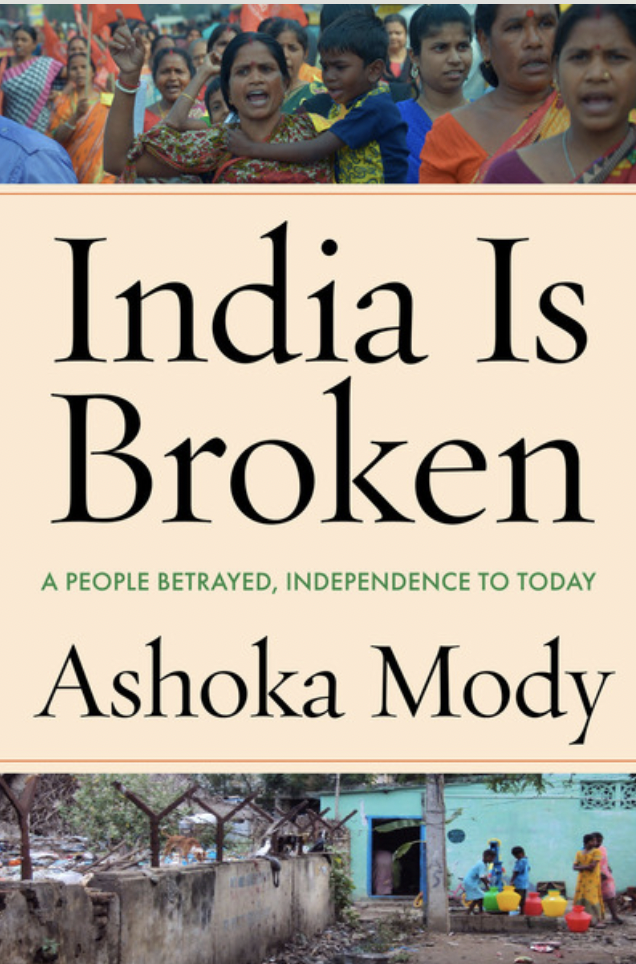
Ashoka Mody, an economic historian at Princeton’s School of Public and International Affairs, who worked at the World Bank and the International Monetary Fund, give a provocative new account of how India moved relentlessly from its hope-filled founding in 1947 to the dramatic economic and democratic breakdowns od today.
When Indians first took control of their government in 1947, they proclaimed the ideals of national unity and secular democracy. Through the first half century of nation-building leaders could point to uneven but measurable progress on key goals, and after the mid-1980s, dire poverty declined for a few decades, inspiring declarations of victory. Today, a vast majority of Indians live in a state of underemployment and are one crisis away from despair. Public goods – health, education, cities air and water and the judiciary are in woeful condition. Good jobs will remain scarce as long as that is the case. The lack of jobs will further undermine democracy which will further undermine job creation. India is Broken provides the most persuasive account available of this economic catch-22.
Challenging prevailing narratives, Mody contends that successive post-independence leaders, staring with its first prime minister Jawaharlal Nehru, failed to confront India’s true economic problems, seeking easy solutions instead. As a popular frustration grew, and corruption in politics became pervasive, India’s economic growth relied increasingly on unregulated finance and environmentally destructive construction. The rise of violent Hindutva has buried all prior norms in civic life and public accountability.
Over the past year India enjoyed the status of the fastest-growing large economy in the world, western bankers and consultants have echoed the optimism emanating from New Delhi.
McKinsey boss Bob St4rnfels told India’s Economic Times last year that it was now India’s Century with the country’s large workforce, changing supply chains and digital leapfrogging all lining up in its favour.
Mody meticulously argues case against this, Indian leaders have made the same mistakes, most saliently neglecting human capital by failing to provide uniformly decent education, healthcare and other public services.
This Mody, says has produced an economy that invariably fails to produce enough jobs or skilled workers, which might have allowed India to achieve the sustained manufacturing growth seen in East Asian countries like China, South Korea, and Vietnam.
‘Nehru’s fascination with the temples of modern India kept him focused on the visible victories of steel plants and fertilizer factories and pushed him away from the administratively complex and long haul effort of creating a world-class education system for India”, Mody writes.
Nehru’s daughter Indira Gandhi doubled down on his poor policy choices, according to this account, and made new ones, including nationalising banks and allowing her son Sanjay to spearhead a wasteful project to develop an indigenous car. Corruption became all pervasive as her Congress party officials exploited India’s licensing regime and entertained ties with rising Indian business groups.
Mody writes “Gandhi was a prime minister in cynical and self-serving socialist garb, making promises to the poor, she had no intention of keeping”.
Mody captures the intertwined political, policymaking, and societal forces that have shaped Modi’s India. By the 1980s and 1990s, companies like Texas Instruments and Infosys were connecting skilled Indian workers to the world, building a globally competitive service sector even it is not the source of abundant blue collar formal jobs India needs.
Mody writes social norms were eroding, with “a dark Indian underbelly” that nurtured Hindutva ( the Hindu nationalism that animates Modi’s Bharatiya Janata party and deepening relationships between politicians and criminals. He identifies corrosive misogyny as one of India’s top economic obstacles, with women withdrawing from the workforce because they feared unsafe neighbourhoods and carried psychological scars.
According to Mody “India faces three challenges it did at Independence in 1947, breathe new life into an ailing agricultural sector, provide many more jobs in an economy that seems chronically unable to create jobs and compete in a much tougher international setting.”
Combining statistical data with creative media such as literature and cinema to create strong, accessible people-driven narratives, this book is a meditation on the interplay between democracy and economic progress with lessons extending far beyond India. Mody proposes a path forward that is fraught with its own peril, but which nevertheless offers something resembling hope.
India is broken by Ashoka Mody, Stanford University Press £29, 528 pages.
 The neptune Herald
Leave a comment