
The history of Silicon Valley, the enclave of Palo Alto, where wealth and privilege are almost palpable, as the YouTube’s early days in the University Avenue, was above a pizza restaurant on the right , while Google and Paypal began in a small office further up, Facebook squatted across the street, the road lead you to the middle of Sanford University.
Palo Alto’s weather is temperate, its people are educated and enterprising, its corporations are spiritually and materially ambitious and demonstrably world-changing. Palo Alto is also a haunted toxic waste dump built on stolen Indian burial grounds, and an integral part of the capitalist world system.
Malcolm Harris, a political activist, claims this is the ground zero for a form of hyper-capitalism, in the same way the California’s early capitalist rode on the backs of state’s original native population along with later wave of Chinese railway workers and Hispanic agricultural labourers. Today the Tech titans are exploiting the labour force from around the world.
Palo Alto starts with railway magnate Leland Stanford, who left San Francisco to settle in rural pace some 30 miles to the south. When 15-year-old Leland junior died suddenly, the grieving monopolist and his wife Jane, founded Stanford University in the boy’s memory. The ageing magnet develops a new and more scientific method for breeding horses. His trainers are happy to push a young colt to tis limits and beyond, snapping its tendons, if that means discovering a weakness sooner, highlighting all about data and control.
According to Harris, with enough money behind it, he says, it is the blueprint for everything that follows. “All a man needed to improve the world was an uncompromising dedication to profit and capital to realize the necessary scale.”
Sanford’s widow dies from an unexplained poisoning that Harris has no qualms blaming on David Starr Jordan, president of the university, and Jordan is left free to stamp his own mark on the institution. Most histories of California’s tech industry make a point of highlighting the yin and yang at the heart of digital technologies: the way they can both empower the individual – the personal computer and the internet which lead to the centralization of power and control today’s internet monopolies and the cloud.
Harris examines how and why Northern California evolved in the particular, consequential way it did, tracing the ideologies, technologies, and policies that have been engineered there over the course of 150 years of Anglo settler colonization, from IQ tests to the “tragedy of the commons” , racial genetics, and “broken widows” theory.
Palo A lot is an urgent and visionary history of the way we live now, one that ends with a clear-eyed, radical proposition for how we might begin to change course. Tech’s only role , as he sees it, has been to devise tools for mass exploitation and to support military aggression, on the wave of Pentagon money that floated California’s tech industry after entire California enterprise oversimplifies a complex history.
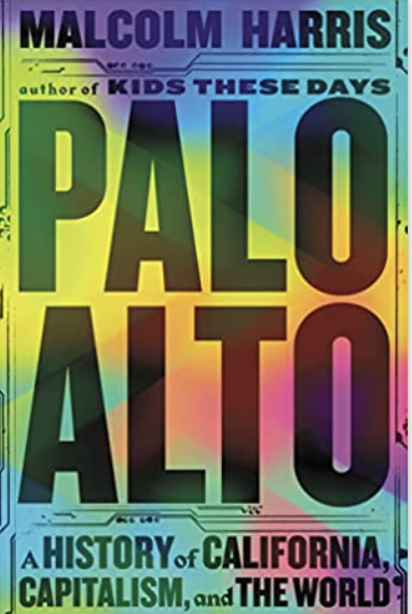
Palo Alto: A History of California, Capitalism, and the World by Malcolm Harris, Riverrun £40/ Brown $36, 720 pages.
 The neptune Herald
Leave a comment