
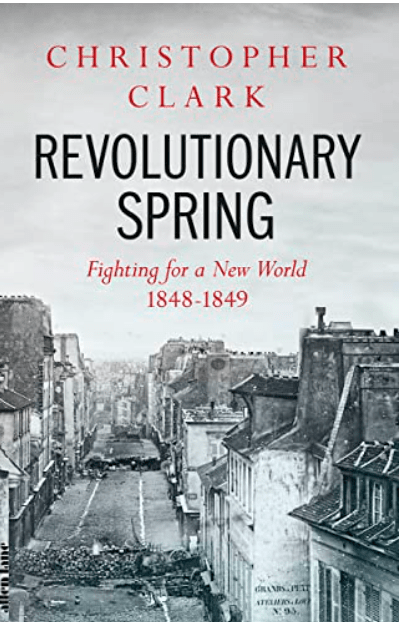
Christopher Clark’s new book recreates the verve, wit and insight into some rulers who gave up, others fought bitterly, but everywhere new politicians, beliefs and expectations surged forward. The role of women in society, the end of slavery, the right to work, national independence and the final emancipation of the Jews all became live issues.
Clark, a regius professor history at Cambridge University, explains vividly the new ideas and then the increasingly ruthless and effective series of counter-attacks launched by regimes who still turned out to have many cards to play. But even in defeat, exiles spread the ideas of 1948 around the world and for better and sometimes much worse- a new and very different Europe emerged from the wreckage.
In January 12th, 1848, revolution spread across Europe as rebellion broke out in Sicily against reactionary Bourbon monarch Ferdinand II. On February 24, the King of the French, Louis Philippe, was toppled by a rising in Paris. A fortnight later the revolution simultaneously reached Vienna, Berlin, Budapest and Milan. By end of March, Conservative monarchies of the continent seemed to have surrendered to popular demands for political rights and national self-determination. Constitutions were granted in Prussia and the major German states, and Italian and Hungarian subjects of multi-ethnic Habsburg empire appeared on the brink of independence.
By 1900 most European states had adopted some form of constitutionalism, several had embraced universal male suffrage, and a few were laying the foundations of a welfare state. The national aspirations of the Italians and Germans , frustrated in 1848, were realised even sooner with the creation of the Kingdom of Italy and the Second Reich, both owe their origins as modern nations to the year of revolutions.
Clark describes the Berlin and Vienna revolutions in granular detail. The 1846 curtain raiser in Galicia as Wallachia rose against its Russian protectors in June 1848. The Vienna Settlement that ended the Napoleonic wars, its strengths and flaws, and the resulting tensions within and between the European states that created the conditions for upheaval in 1848. The Habsburgs showed themselves especial masters of this game: they left Vienna when their situation became dangerous, replace an incapable emperor with is more vigorous nephew, then returned with reliable troops to crush their opponents.
Revolutionary Spring: Fighting for a New World 1848-1849 by Christopher Clark, Allen Lane £35, 896 pages.
 | ReplyForward |
 The neptune Herald
Leave a comment