
The New Labour Government of Tony Blair was criticized by columnist Will Hutton for misusing the work of the American twentieth century’s greatest political philosopher John Rawls, who died in 2002, aged 81. Hutton highlighted how Ministers routinely appealed to a “bastardi§sed Rawlsianism” to justify widening levels of inequality.
According to Rawls’ liberal-egalitarian notion of “justice as fairness”, set out in his A Theory of `justice (1971), we need not worry about the gap between rich and poor so long as there is a basic level of social support for the worst off. The problem according to Hutton, was this is not Rawls’s conception at all”.
Economist and philosopher, Daniel Chandler’s lucidly written book attempt to establish what Rawls really thought and to argue that his work in fact invites us to “ Change our most basic political and economical institutions. Taxing the high earners and corporations more, a familiar staple of mainstream social democratic thought, and also in Free and Equal for a dramatic expansion of “Workplace democracy”.
Imagine you are designing a society, but you don’t know who you’ll be within it- rich or poor, man or woman, gay or straight and what would you want the society to look like?
By rediscovering this revolutionary thought experiment proposed by John Rawls, is essential that we find a way out of escalating crises that are devastating our world today. Chandler builds a case for progressive agenda that would fundamentally reshape our societies for the better. He shows how we can protect free speech and transcend the culture wars, get money out of politics, and create an economy where everyone has the chance to fulfill their potential, where prosperity is widely shared, and which operates within the limits of our finite planet.
This book galvanizes alternative to the cynicism that pervades our politics. Imagine being asked to cut a cake into five slices without knowing which slice you’ll end up with. Rational self interest dictates you would cut slices of roughly equal size. Similarly, the participants in Rawls’s thought experiment , behind the veil of ignorance, choose two fundamental principles of justice: a “basic liberties principle”, which says that everyone has an equal claim to a suite of fundamental rights and liberties, a pre-condition of liberal democracy, and a different principle , according to which social and economic inequalities can only be justified
To the extent that hey benefit the worst off.
This latter principle Hutton thought New Labour had traduced which according to Chandler had far reaching implication for the question of how economic institutions should be organised. The Optimum level of taxes and inequality might be, but the principle is not a justification for laissez-faire economics or a welfare state that provides only a basic safety net. Chandler is asking us to “prioritise the life chances of the least well-off and the prevailing ideas about economic justification on both left and right.
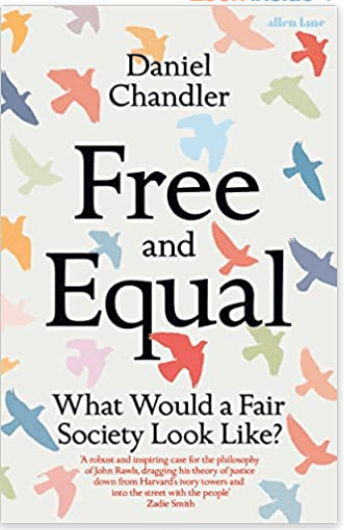
Free and Equal: What Would a Fair Society Look Like by Daniel Chandler, Allen Lane £25, 416 pages
 The neptune Herald
Leave a comment