
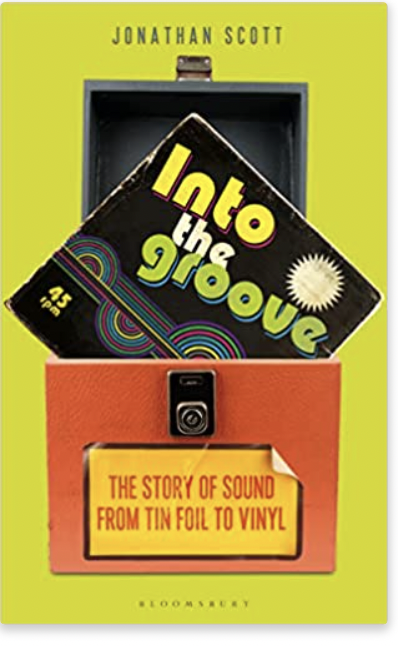
Vinyl collector and music buff Jonathan Scott dissects the feat that we all take for granted today the domestication of sound, and bring us the story of recorded sound and technological developments, the people that made them happen and impact they had on society from the earliest inventions via the phonographs to LPs, EPs and recent resurgence of vinyl, travelling through a history of geniuses, eccentrics and upstarts who brought us the vinyl records in music’s most durable format. New Vinyl outsold CDs in the UK last year for the first time since 1987, although streaming with worth £1.6bn against vinyl albums’ £150 million. Scott’s book billed as “Vinyl ‘s origin story”, and throw light into why records refuse to die, and the sheer quality achieved by the succession of engineers and capitalists who by the late 1940s, had invented and marketed light weight plastic discs scored with concentrated , lateral-cut grooves of varying widths and uniform depth. Scotts chronicles the technological history of the domestication of recorded sound, which accelerated in Europe and the US from the 1850s to the breakthroughs of the late 1940s in a concentrated burst of scientific ingenuity. Thomas Edison’s phonograph, which was first promoted as a serious piece of business kit, Alexander Graham Bell and Peter Goldmark, the book features various eccentrics, tinkerer’s and upstarts who helped develop a vivid market.
Colonel Gouraud, a French-American civil war veteran who in the 1880s appointed himself as England’s chief promoter of Edison’s products, from his south London home full of cutting edge gadgets like electric lights triggered by opening doors, its billiard room converted into what was probably Britain’s first recording studio. Gouraud bought an Edison perfected model of 1888 and gather famous friends for “phonograph parties” in which various socialites, literary types and musicians took turns to record their voices. Arthur Sullivan, the composer of light opera, recorded: “ I am astonished … at the wonderful power you have developed, and terrified at the thought that so much hideous and bad music may be put on record forever”.
Much of Victorian excitement was about the possibility of hearing once again the voices of the dead, not of enjoying music on demand. Scott points us to online archives of early recorded sound, mostly freely available. While Thomas Edison’s phonograph, the first device that could both record and reproduce sound, represented an important turning point in the history of recorded sound, it was really only the tip of the iceberg, and came after decades of invention, tinkering and experimenting. Into the Groove, tells the story of the birth of recorded sound, from the earliest serious attempts in the 1850s all the way upto the vinyl resurgence we’re currently enjoying, as the book celebrates the ingenuity, rivalries and science of the modulated groove. A recording made by Gouraud on a summer’s afternoon in 1888 of a large scale performance of Handel’s oratorio “Israel in Egypt” at the Crystal Palace in London, which he made with his phonograph and a batch of paraffin cylinders – one of the earliest recordings of live music known to exist.
Scott examines the first attempts to record and reproduce sounds, the origin of the phonograph, and the development of commercial shellac discs, and later moves through the fascinating story of the LP record, from the rise of electric recording to the fall of 7-inch vinyl, the competing speed and format wars, and an epilogue that takes the story up to the present day return of vinyl to vogue mania.
Scott uncovers tales of intrigue and betrayal, court battles and lesser known names who are often left out of most histories.
Into the Groove: The Story of Sound from “Tin Foil to Vinyl by Jonathan Scott, Bloomsbury, Sigma £17.99, 320 pages.
 The neptune Herald
Leave a comment