

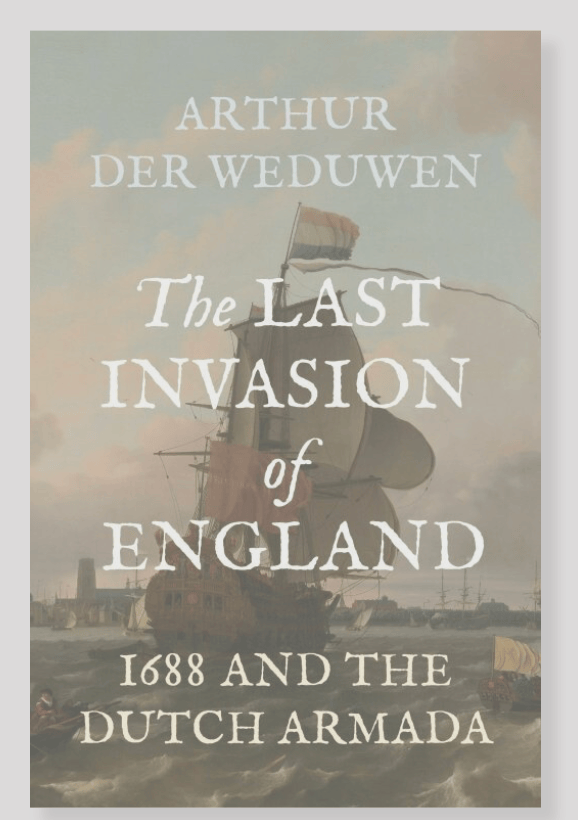
Arthur der Weduwen, in The Last Invasion of England: 1688 and the Dutch Armada, strategises political risks and fake news by presenting an electrifying narrative history that reframes Britain’s glorious constitutional revolution of 1688, the autocratic Catholic King James II was ousted by his subjects and replaced by his subjects and replaced by his Protestant daughter Mary Stuart, wife of James’s nephew, the Dutch William III of Orange, Devoted to her husband, Mary would not accept the crown alone, and so William and Mary were crowned together, securing a smooth dynastic succession. He recounts the forgotten campaign that carried William and his army to English shores and led directly to James’s fall, bringing a revolutionary age vividly to life and rewriting the history of Britain, Europe and the transatlantic world more widely.
Back in December 1688 an inflammatory pamphlet typical of fake news, appeared in London, the so called ‘Third Declaration: of William of Orange, the Dutch leader whose armies had invaded England one month earlier, alleging there was a Catholic plot to seize control of the capital and murder Protestants. The pamphlet was not written by William, but by Hugh Speke, an anti-Catholic agitator. Panic gripped the populace, and anti-Catholic riots, which had already broken out in other towns, spread across the city. Arthur Der Weduwen, a Dutch-born historian at the University of St Andrews, mentions this episode as a way of cautioning us against reading history backwards. With the important exception of Ireland, the events that came to be known as the Glorious Revolution took place in a mostly peaceful and orderly manner. To many English politicians and historians, it seemed as if divine providence had intervened on the nation’s behalf to save it from Catholicism and put it on the road to parliamentary sovereignty, constitutional monarchy and empire.
The Dutch Armada took immense risk and near failures of the last seaborne invasion of England which occurred exactly one hundred years after the defeat of the Spanish Armada. The sixteen thousand Dutch troops who accompanied William were not on hand for moral support. They came with sword, musket and cannon. The political revolution in Britain could not have been achieved without the willpower, might and resources of William and the Dutch nation, and explains why the Dutch Republic, a small state that celebrated peace and commerce above all else, would dare to undertake reckless pre-emptive military strike on its more powerful neighbour. Transforming our understanding of the Glorious Revolution and Britain’s ascendancy as a global powerhouse, many from leading protagonists who prepared and executed the invasion, evoking the historical realities of the women and men who lived during turbulent and uncertain times.
Williams did not need to fight a major battle in England to overthrow the Catholic James II, as he took the crown as joint monarch with his wife Mary, who was he ousted king’s Protestant daughter, and he oversaw a fresh settlement for a country torn apart in the 17th century by political and religious quarrels, not to mention civil war.
“William’s principal motivation for the invasion of England was to draw Britain into a permanent alliance against France and his concern for the religion of England was also genuine… he understood that the religious policies advanced by James had the potential to reduce Britain to civil war or, even worse, turn it into a French auxiliary state” write der Weduwen. William’s armada was “the greatest fleet ever to have sailed the North Sea, carrying 16, 000 soldiers on 48 warships, over 240 transport vessels and numerous other ships. He lists the provisions brought to sustain the invaders: huge amounts of herring, cheese and beer.
The invasion could easily have gone wrong as storms foiled William’s first attempt to set sail. The winds that assisted the second expedition on November 11 to 15 also prevented the English Navy from engaging the Dutch fleet. William landed at Brixham in Devon and spent the night in a fisherman’s cottage. Der Wedwen notes that the soldiers were astonished to see English women and children smoking pipes.
James was demoralised by the defections to William of Military officers, politicians and even his second daughter, the future Queen Anne. He tried to flee to France, but fisherman caught him off the Isle of Sheppey. In January 1689, William turned a blind eye and let James escape custody and cross to France. James was declared to have abdicated and the throne was awarded to William and Mary. Legislators adopted a Declaration of Rights, turned later in 1689 into Bill of Rights, that was celebrated in centuries to come as a cornerstone of British liberties.
The Last Invasion of England:1688 and the Dutch Armada by Arthur der Weduwen, Princeton University Press £30/ $39.95, 440 pages.


This factual historical book seems like a very intensive and fascinating read. One can almost visualize the characters and their conquests and their arrival on the oasrt5.
LikeLike