

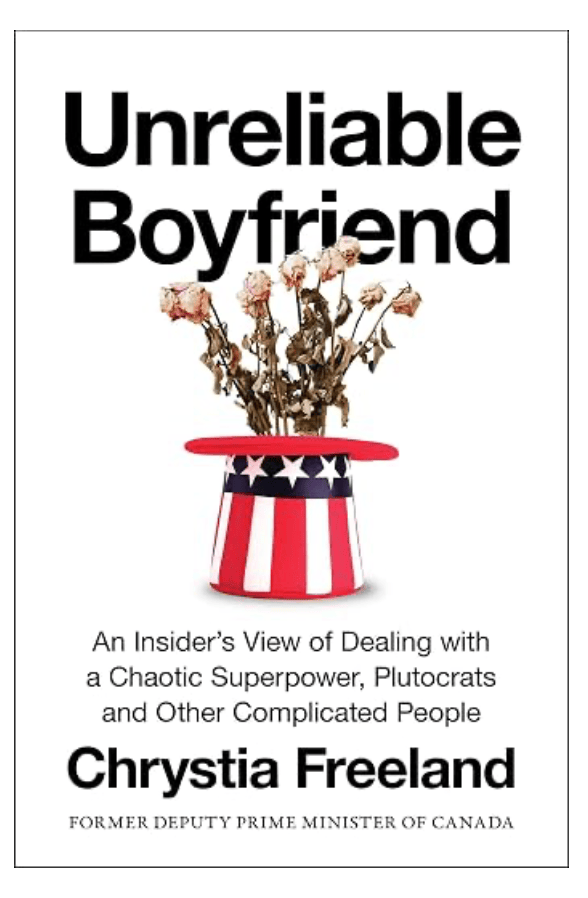
Chrystia Freeland, Canada’s former deputy prime minister, a renowned journalist, activist, adviser and policymaker, gives a provocative and rare insider account of how a new generation of Western plutocrats manoeuvre power from behind closed doors – and how liberal democracy can fight back against Trump’s increasingly predatory behaviour.
Freeland spent decades reporting how foreign dissidents and oligarchs from Moscow to China and beyond exploit economic upheaval and hollow out the lives of ordinary people. As a political leader and fierce negotiator, she brought these lessons into halls of power, only to encounter a new order of global elites and tyrannical regimes-this time in the West itself.
For many Canadians, US President Donald Trump’s unjustified and erratically applied tariffs, combined with threats of Canadian sovereignty, have alerted longstanding partnership. Freeland’s book- part memoir, part policy roadmap-chronicles her journey from a small town Canada to Harvard, and then to Oxford University as a Rhodes Scholar. As a student, she spent time in Ukraine, just before Ukrainian independence in 1991, and subsequently learnt that KGB had a file on her. She worked in Russia during its tumultuous transition, its Wild West period, when the oligarchs were capturing the country’s wealth.
Now, at a time when authoritarianism is resurging around the world alongside rising tariffs, economic anxiety, and democratic instability, she shines a light on the current crisis of liberal democracy. With bold and unusual candour, Freeland exposes how deals are really made, how coalitions fracture when governments fail to deliver for working people and argues that trade security and democracy can no longer be separated. Instead democracies must build new alliances strong enough to resist foreign autocrats and homegrown oligarchs.
Freeland held some of the highest positions in the Canadian government including minister for international trade, foreign minister, finance minister and to resign as Deputy prime minister in December 2024, ushering in a transition at the top of Canadian politics.
“We are living in a time of three big fights,” Freeland explains “The fight between Democracy and dictatorship, the fight between people and plutocrats, and the fight between global alliances and predatory isolationism.” She offers a road map for Canada and allies to survive and thrive without being subservient to Trump’s bullying. She call it “friend-shoring’, in which like-minded countries tightly enmesh trade and security realtionships. Friendshoring would ensure that the post-second world war values survive, values that were largely forged by the US, even if the US no longer has an interest in abiding by them, and would provide a necessary buffer against authoritarian behaviour.
Take two recent own goals: thanks to Trump, Iran has weaponised the Strait of Hormuz and China has weaponised its dominance over rare earth production after Trump threatened China with tariffs at over 100 per cent. In both cases, Trump retreated from his initial all-or-nothing stance, and other countries have taken note. Freeland’s book emphasises how those countries are now rightly focused on rebuilding their own defence and resilience against future shocks, and not acting just to avoid hectoring by a future American president. This book should be read by Americans who care about international alliances and want to restore what they can in the post-Trump era. Like most betrayals, especially in close relationships, they are not easily forgiven or forgotten.
Unreliable Boyfriend: An Insider’s View of Dealing with a Chaotic Superpower, Plutocrats and Other Complicated People by Chrystia Freeland, Simon & Schuster £25/ Simon Six $30, 416 pages.

