

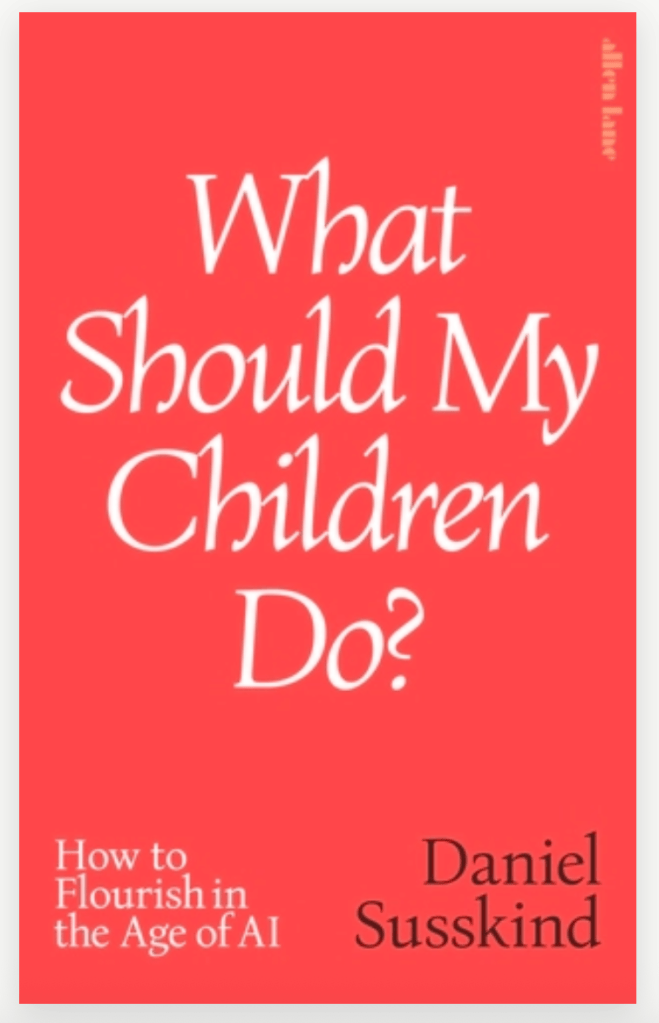
Imagine a world transformed by artificial intelligence, and what should my children do? AI is rewriting the rules in the classroom, the job market and the workplace, leaving parents, teachers, students and all types of workers unsure about how best to prepare for what lies ahead. Globally renowned economist Daniel Susskind, author of Growth, one of Barack Obama’s favourite books of 2024, cuts through the outdated advice to reveal to us what young people actually need to succeed now. “We cannot be sure the advice we give our children last year still works for the next” Susskind explains by offering hope that our children can prosper if they embrace the “extraordinary” opportunities that AI brings, if they bolster their critical thinking skills and avoid the distraction of social media.
We should not ban tools or discourage new skills that are in demand Susskind argues, or cling to inherited ways of working. Instead, he reveals how people can master new technologies without eroding other essential skills. From reorganizing the curriculum to re-imagining white-collar careers, Susskind maps a smarter, more productive path forward.
We live at an extraordinary technological moment. Every day, it seems, we hear about machines taking on tasks that we thought only human beings would ever do: making medical diagnoses and composing jokes, drafting legal arguments and designing beautiful buildings, writing lines of code and even forming relationships. The leaders of the largest AI companies now claim that within a few years, we will build an AI that can outperform us at very tasks that we do. Susskind who has been exploring the impact of technology on work. Recent developments in AI- ChatGPT, Claude, Gemini, Grok are an astonishing new chapter in this story. And today, the most common question people have is clear: What should my children do? This book is also for anyone thinking about their career, asking how to respond to the turmoil that is underway in the working world, as well as for business and political leaders experiencing the same upheaval.
Susskind advocates using generative AI to train junior professional through the kind of simulations deployed in sectors such as engineering and Formula 1. “If simulated learning is good enough to train the next generation of nuclear power plant managers, then it ought to be able to do the same for the next generation of say, accountants.” Susskind writes.
Susskind, a father of three, describes how his children and he used ChatGPT to generate a passable Dr Seuss-style story which they then had fun embellishing. This particular example felt overly enthusiastic. Susskind thinks we will have to watch human athletes and musicians than robots, trust human judges and politicians with moral decisions, appreciate handcrafted things, and value human empathy in healthcare, social work, psychotherapy, spiritual guidance and teaching. Humans are, after all, still playing chess tournaments, 30 years after Deep Blue beat Kasparov. We must learn to be “active critics” because AI is very prone to errors. The author agrees with the economist Tyler Cowen that one-third of every university course should be devoted to AI. When Susskind taught economic to Oxford undergraduates, he says, he would take about a third of their time to teach them mathematics alone- to give them critical thinking skills they could apply in whatever else they chose to study. The biggest challenge, he thinks, will be to teach people to flourish using AI without setting them up to forget crucial basic skills such as reading, writing, maths and scientific analysis. He thinks AI will reinvent and radically improve personalised learning, and will do so throughout life. He urges each one of us to focus on “who you are, not what you do”. We should think about education not just in terms of churning out more productive workers but also better citizens.
He thinks that AI will reinvent and radically improve personalised learning, and will do so throughout life. Parents need to shore up our children’s ability to focus. A third of Americans aged 13 to 17 are on social media “almost constantly”, Susskind writes. Earlier generations had similar worries: when England introduced the universal postal system in 1840, people feared constant interruption with 12 deliveries of letters a day. But today’s technologies pose a whole new challenge because distraction is not a byproduct: It’s the business model.
With his deep knowledge of AI and how the world of work is changing, professor Susskind offers an evidence-based look at the problem and a practical path forward.
What Should My Children Do? How to Flourish in the Age of AI by Daniel Susskind, Allen Lane £20/Penguin Press $30, 240 pages.

