

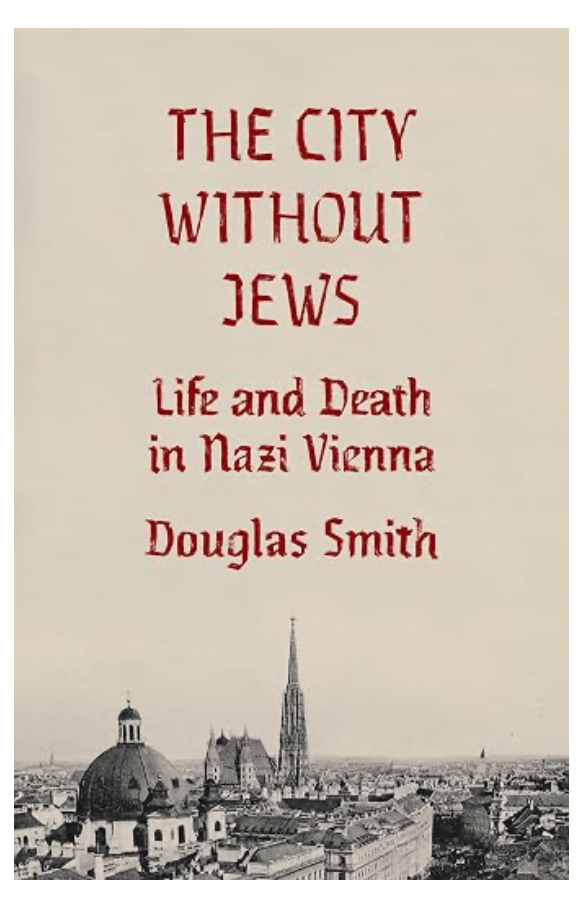
In The City Without Jews, award-winning historian Douglas Smith, explains what Viennese meant stepping beyond the limits of one’s identity into a cosmopolitan world of Kultur, where race and religion could be hidden behind a veil of refinement and achievement. Vienna was once a city in which Jews did not have to be Jews, and singular story of the destruction of Jewish Vienna as seen through the letters and diaries of an extraordinary woman who witnessed it all. In 1922, Hugo Bettauer published the novel The City Without Jews, a satirical critique of Austrian antisemitism. Three years later he would be killed by an early follower of the Nazi Party. More than a decade later, in March 1938, the novel’s terrifying vision of a Vienna emptied of Jews would begin to be realized. German troops poured into the glittering city, making the beginning of seven years of unfathomable state-sanctioned violence against the Jewish population.
Douglas Smith in Nazi Vienna tells the dramatic story of these seven years as they have never been told before. Drawing on hundreds of sources, many of which have lain untouched for decades, Smith captures with novelistic immediacy the intertwined lives of those who experienced this age of extremes. And of all these voices ones stands out a middle-aged nurse named Mignon Langnas, a Jewish woman who wold see all her friends and family, and her entire world disappear. The only Jew who spent the entire seven years in Nazi Vienna and left behind such a detailed record of her life, Mignon, in her letters and diaries, shows herself to be a woman of exceptional strength, compassion, and dignity, seeking to make sense of the once-vibrant city that had now turned against her. This is a true account of how one of Europe’s largest Jewish population was annihilated, a depressingly familiar story within the wider context of the Holocaust. Smith explains “One of loss, fear, terror, despair, longing, even hope, is written under the Nazis”. Mignong and her family moved to Vienna at the start of the first world war from Galicia (now split between Poland and Ukraine). She married Leon Langnas in 1928. He built a business. They had two children. Sibilings, cousins, aunts, uncles and friends did the same. After the Anschluss their lives began to crumble, each in their own way. The state no longer saw them as citizens, but as Jews. Their businesses were expropriated. Neighbours and employees turned on them. They were beaten and humiliated by uniformed men, forced to scrub the streets on their hands and knees, prompting them to leave Vienna. Despite labyrinthine bureaucratic hurdles, it would facilitate the esacpe of around 120,000 Austrian Jews by 1940, that included Leon and Mignon’s two children, but not Mignon herself. America’s entry into the war in late 1941 meant “Vienna’s Jews were effectively cut off from the outside world” just as the Nazi regime turned to more radical methods of destruction. Trains began to carry away Vienna’s Jews by the thousands in 1941, intensifying in 1942, by which time there were only 7,989 Jews left in Vienna. There had once been 200, 00. Mignon’s survival was largely lucky, in January 1945 the family home was struck by an American bomb. She stood a few steps away from death. Sixty-six thousand Jews had perished I the Holocaust. Most of the rest had left, never to return. Mignon was among them. Cosmopolitan Vienna had been replaced by a provincial city where Jews remained people of uncomfortable history everyone did their best to forget.
The City Without Jews is the story of the destruction of Jewish Vienna in previously untapped breadth and detail, a reminder and a warning of the consequences of forgetting a past whose legacy refuses to die.
The City without Jews: Life and Death in Nazi Vienna by Douglas Smith, Picador £30/ Farrar Straus and Giroux $37, 560 pages.
 The neptune Herald