

Amid women facing backlashes across the world, growing dangers for women, as their safety is being threatened and their freedoms are under attack, with authoritarian states, online misogyny and climate breakdown, wildfires burning in Europe and drought ravages harvests and apocalyptic summer of 2026.
Academic and activist author Natasha Walter after decades of her advocacy work alongside refugee women: “When heat rises, so does male violence. The ecological crisis is amplifying every threat to women. Women’s bodies and the body of the earth in danger at one on the same time.”
She wrote, The New Feminism ( 1998), an upbeat, as many women then were, fuelled by the hopeful rise of New Labour and cool Britannia, when she was in her early thirties. Walter writes now that “ I even lauded Margaret Thatcher for her undoubted ability to break down feminine stereotypes of unobtrusiveness and passivity.” Today feminism is trapped in a cycle of consumerism and sold to women as individual empowerment. The result is that women are struggling to build connections with one another and with the world around them. “While women are encouraged to focus on our energy healing and our morning rituals, what we are forgetting, and what still needs to be done?” Walter’s latest book aims to answer those questions. In her blueprint for how to fight back against forces that seek to destroy both the planet and women’s rights, Walter argues for a global, grassroots feminism. She highlights that the richest 22 men in the world have more wealth than all the women in Africa combined. Statistics such as this make it easy to feel hopeless, but Walter’s prose is sparky and surprising, even as she outlines the dismal rise of misogyny and the global backlash against women’s rights.
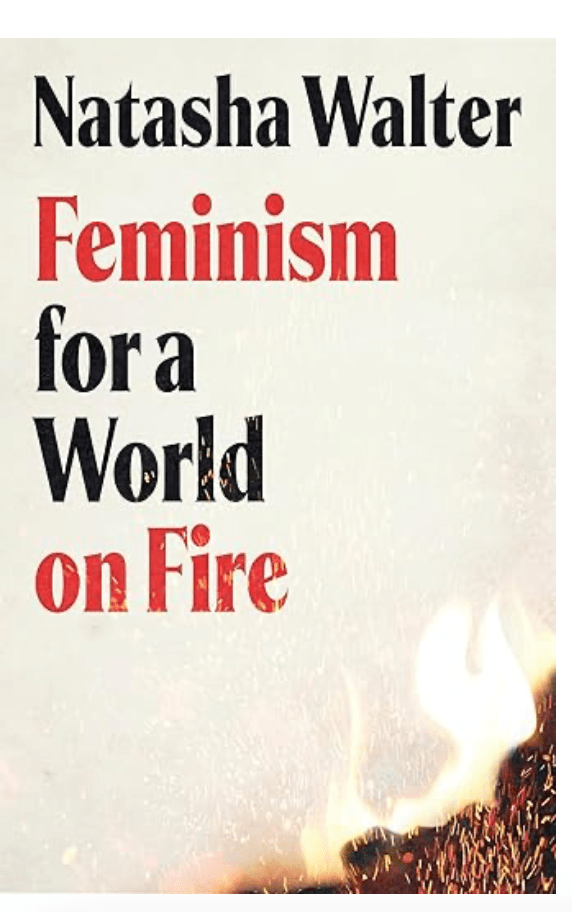
Feminism for a World on Fire has three parts. Heavy weather charts the recent history of women’s movements, as collective goals of the 1970s gave way to consumerism. “Approaching Storms” describes how the internet first seemed to offer a better version of the consciousness-raising groups that powered first-wave feminists. “For many years, it seemed that women would not only find one another and build connections online, but they would also be able to use those virtual connections to create change in the real world.” Constant scrolling on social media has “flattened” everything, including human connection, and the misogynists and conspiracists have taken over X. There is also, “a strange inertia and sense of fatalism about digital harms for women”. Growing authoritarianism and splits in the feminist movement (she makes very careful reference to the divisive debate over the rights of transgender people) and we are in a perilous place Walter notes.
In part three, “Tomorrow’s forecast’, to inject hope and galvanise action. The “World on Fire’ has already arrived, as Walter prescribes radical change: “Environmentalism without feminism is just the patriarchy in a forest. Women can only thrive when their ecosystems thrive” Walter explains.
Walter mentions the big-money philanthropists who ignore effective work done by women who know what their communities need, and instead impose their own plans on areas form which they are far removed. “When I feel really lost about the way forward it’s often the women around me who keep me going”.
Walter advises us to focus our energy and cash on community-based environmental activism, “wherever we are, I think there is a relationship with the place to tend and to mend.” Walter writes.
Walter moves decisively beyond individualism to build a vision of a rooted feminism that can connect women’s liberation to other movements for equality and environmental protection. A world were women can thrive together on a flourishing planet may sometimes seem like a distant dream- but it is still within our grasp.
Feminism for a World on Fire by Natasha Walter, Virago £25, 368 pages.

