

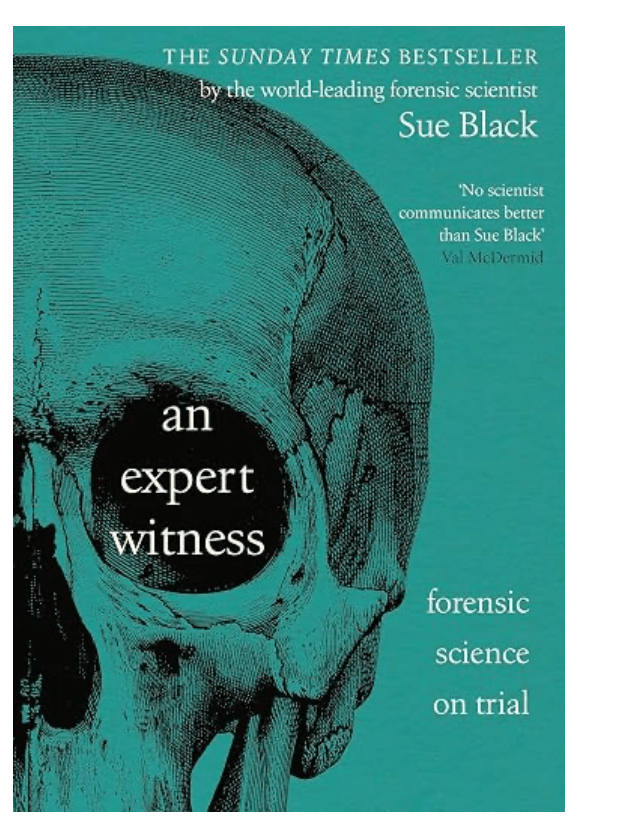
UK’s leading forensic anthropologist and pro-vice chancellor of Engagement at Lancaster University, president of St John’s College, Oxford, Professor Dame Sue Black solves the mysteries of harrowing and shocking criminal cases by assessing its triumphs, failures and future. For over forty years, Black has analysed criminal evidence at the highest level. She stood in court as an expert witness, repeatedly putting her research and reputation on the line, all in the name of justice.
True crime cases from historic poisonings to modern sexual offences, Sue Black traces the evolution of forensic science from early identification methods to more recent breakthroughs such as DNA profiling, even Sue’s own vein identification research, and the emerging role of artificial intelligence in criminal investigation.
She reveals where science has delivered justice, and where failures have led to devastating consequences, including wrongful convictions such as that of Andrew Malkinson, imprisoned for seventeen years for a crime he did not commit.
She reflects on life serving as an expert witness, and looks back at landmark cases to tell the story of forensic science, ask questions for its future, and explain why this book marks the close of a defending chapter in one of the most extraordinary careers in modern forensic science.
The expert witness is at the crux of the relationship between law enforcement and science and the legal system. When that relationship works well, it makes for a compelling fiction, television, and movies. When it works less well, it make for compelling and explosive news headlines.
In Dissection of an Expert Witness, Sue Black puts the relationship between these different institutions, and now they affect and are affected by the expert witness, under the microscope. Using shocking landmark cases that expose both the strength and weaknesses of the interconnection between disciplines- she in which cases did we get it right? I which did we get it wrong. And if we had differently, might the pendulum of justice have swung another way?
Incisive and compelling, following the impact of advances in technology to changes in funding and the effect of our gladiatorial system, Sue Black tracks the journey of this most intriguing of sciences through to its inevitable conclusion- and the toll it may take not only on experts but ultimately how justice plays out.
We read of a case in which she was involved where the issue was whether certain bone fragments were those of a dead child. Black does not name the defendant, but it was the trial of Mark Bridger, whose abduction and murder of five-year-old April Jones in Wales in 2012 was one of the more appalling cases of the past 50 years.
Unlike many non-lawyers who come into contact with the criminal justice system, Black had a precise understanding of its dynamics and procedures. It is in her accounts of her courtroom experiences that the book really comes alive. We can feel the tension of the cross-examination she has had to endure.
Black gives the readers a tour through the history of English criminal procedure, going back to trial by ordeal in the Middle Ages, and traces the development of criminal investigation.
The concept of expert witness emerges in the 18th century, with “men of science” permitted to testify based on direct knowledge of the relevant facts. In the 19th century the expert takes centre stage in the murder trial, detecting through new-fangled processes the presence of arsenic in those Victorian poisoning cases that continue to capture the public imagination.
Who knew of the extraordinary history of ear identification? Or gait analysis, which identified bow-legged armed robber John Saunders in 2000? Or hair analysis featured heavily in the trial of serial murderer John Christie?
Black also mentions the dubious early 20th century pathologist Bernard Spilsbury, whose evidence sent many to the gallows, and who achieved such pre-eminence that his testimony was accorded the status of near-papal infallibility, even when it was lacking in foundation. His confident identification of Mrs Crippen’s body in the basement of the house she shared with her husband is now the subject of fierce debate.
Black makes references to Robert Churchill, the ballistics expert who appeared in many of the great murder trials of the early 20th century, and whose biography, The Other Mr Churchill, is a minor classic of crime writing, and Arthur Conan Doyle described as the most eminent forensic scientist in Europe- to Sherlock Holmes’s disgust, because he was relegated to second. We discover that Alphonse Bertillon, the creator of an entire system of human identification, eventually came a cropper when he set himself up as a handwriting expert in the Dreyfus Affair, the 1890s French political and military scandal. One of Black’s hobby horses is the expert who steps outside their field of knowledge.
Black writes “I once assisted with the case of a relatively fresh human head recovered from a cow pasture”. The fiancé of the prisoner Mary Blandy is described as “no great shakes in the looks department”.
An Expert Witness: Forensic Science on Trial by Sue Black, Doubleday £22, 400 pages.

