

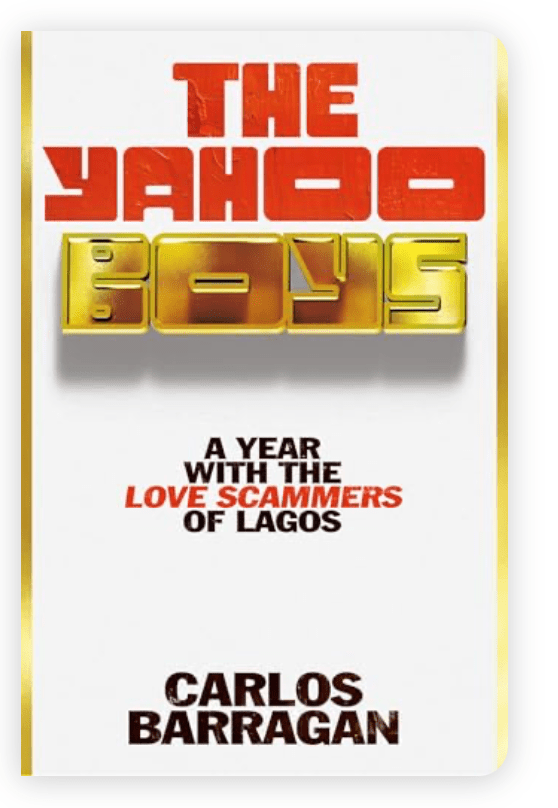
Spanish journalist, Carols Barragán’s “The Yahoo Boys” is about four young romance scammers in Lagos, Nigeria, exploring how and why they scam, and moral dilemmas they face. When is mother started emailing with a handsome American soldier who promised to send gold bars to her Madrid apartment, Barragán came face to face with the human toll of online romance fraud. After tracing the emails to an IP address in Nigeria, he travelled to Lagos to find his mother’s scammers and stumbled on a bigger story. There, in a crowded and impoverished neighbourhood in the midst of Africa’s largest city, he encountered thousands of young men engaged in romance scamming. They call themselves “Yahoo Boys,” and each year they steal millions of dollars from lonely victims overseas, building a dizzying local economy from their phones.
In the Yahoo Boys, Barragán takes us inside the lives of four of the Yahoo Boys of Lagos. We meet Biggy and Chibuike, each struggling with the temptations of fast money; Azeez, a tailor’s apprentice caught between the lure of crime and Nigeria’s economic crisis; and Richie, who believes he caused the death of a Kentucky woman who was his victim for years. Some Yahoo Boys attain the status of folk heroes, buying houses and cars with the money they steal, while others become dependent on drugs and “cash out” – successfully scam a victim- only to lose it all.
Through the Yahoo Boys’ twisting fortunes, Barragán discovers the psychological tactics they perfect, the brutal economic realities that drive them, and the moral dilemmas they confront. A work of radical empathy, this book reveals the human face behind a global phenomenon, and shows how loneliness in the West and poverty in Nigeria are two sides of the same coin.
Nigeria young internet scammers posing as young women or dashing celebrities, scam westerners too lonely or too naive to see the warning signs, and how they convinced a well-educated middle-class woman in Madrid to bare her soul to a stranger online?
The young men straddle a strange “intersection between western loneliness and Nigerian poverty”. But what begins as an effort to understand how his mother could have fallen for a con artist become a dissection of the realities and motivations of the scammers themselves. It is a “story rooted in a real place, with real people, shaped by the weight of history, technology, and the global economy”.
The Yahoo Boys whose name derives from the email provider that first connected them to the world, are often young, drug-saddled and reliant on scripts downloaded online. At the other end of their scam is a cohort of isolated and ageing westerners with nobody to talk to. Crushing western loneliness is the common thread that ties these painstakingly reported tales together.
The accounts of relationships, peppered with direct extracts of conversations, are enthrallingly – not a little perversely- voyeuristic.
Theresa, a middle-aged Irish woman who is scammed out of €78, 000 over four years by chibuike, surely realises that she is not speaking with the American mixed martial arts star Cody Rhodes,” she tells him, after he has stood her up 25 times, texted her from a phone number with a Nigerian dialling prefix and drained her savings. “I’m in love with your voice.”
Barragán’s research reveals there could be tens of thousands of young Lagosians dabbling in scamming. Nigeria has long been associated with online frauds. But a recent cost-of-living crisis, born of shock economic therapy, has provided an added incentive for people without work or prospects to explore alternative ways of making ends meet.
The criteria is straightforward: If you have a mobile phone, write fluent English and have patience, then you can fill the romantic and sexual voids of needy westerners and defraud them. “ To understand victims of romance scams send money, you have to momentarily suspend disbelief and accept the relationship as real,” writes Barragán – adding that some can be pushed so far into debt that they lose their homes.
Romance scamming is an industry dependent on the weird economics that the internet has made possible: scammers ask their lovers to send them cryptocurrencies or easily redeemable items such as gift cards for well-known stores or video game platforms. Those cards, which can be redeemed anonymously, are then sold on, cards for gaming platforms, for example, go mostly to Chinese intermediaries whose clients seek to skirt the Great Firewall to play western games banned in China. When the scammers find someone willing to send them money, they keep the relationship, going at all costs. They order flowers and rings to give their new relationship a sense of being grounded in reality, and they create memories and routines, and set up other accounts to flesh out their lies. When things become testing, they threaten and bully.
One woman, whom Barragán tracks down in Kentucky, fakes her own death to extricate herself from a relationship with a scammer turned sour. The Yahoo Boys enjoy the spoils, as they move into hotels, splurge on clothes, drugs and alcohol, and plough money into supporting up-and-coming musicians. But it never lasts according Richie, one of the Yahoo Boys “If you don’t invest it, you can’t keep it. You have to spend it.”
Yahoo Boys eventually get scammed themselves by girlfriends, drug dealers and the Chinese intermediaries they sell on to.
According to Barragán “there is not well-organised, well-oiled scamming machines operating out of Nigeria as most of these young men weren’t master manipulators, they were just fulfilling unmet emotional needs, relying of repetition and recycle scripts”. But Yahoo Boys offer something that even real relationships struggle to provide “ consistent, undivided attention.”
The Yahoo Boys: Real Life With the Love Scammers of Lagos by Carlos Barragán, Weidenfeld & Nicolson £22/Farrar Straus and Giroux $29, 304 pages.

